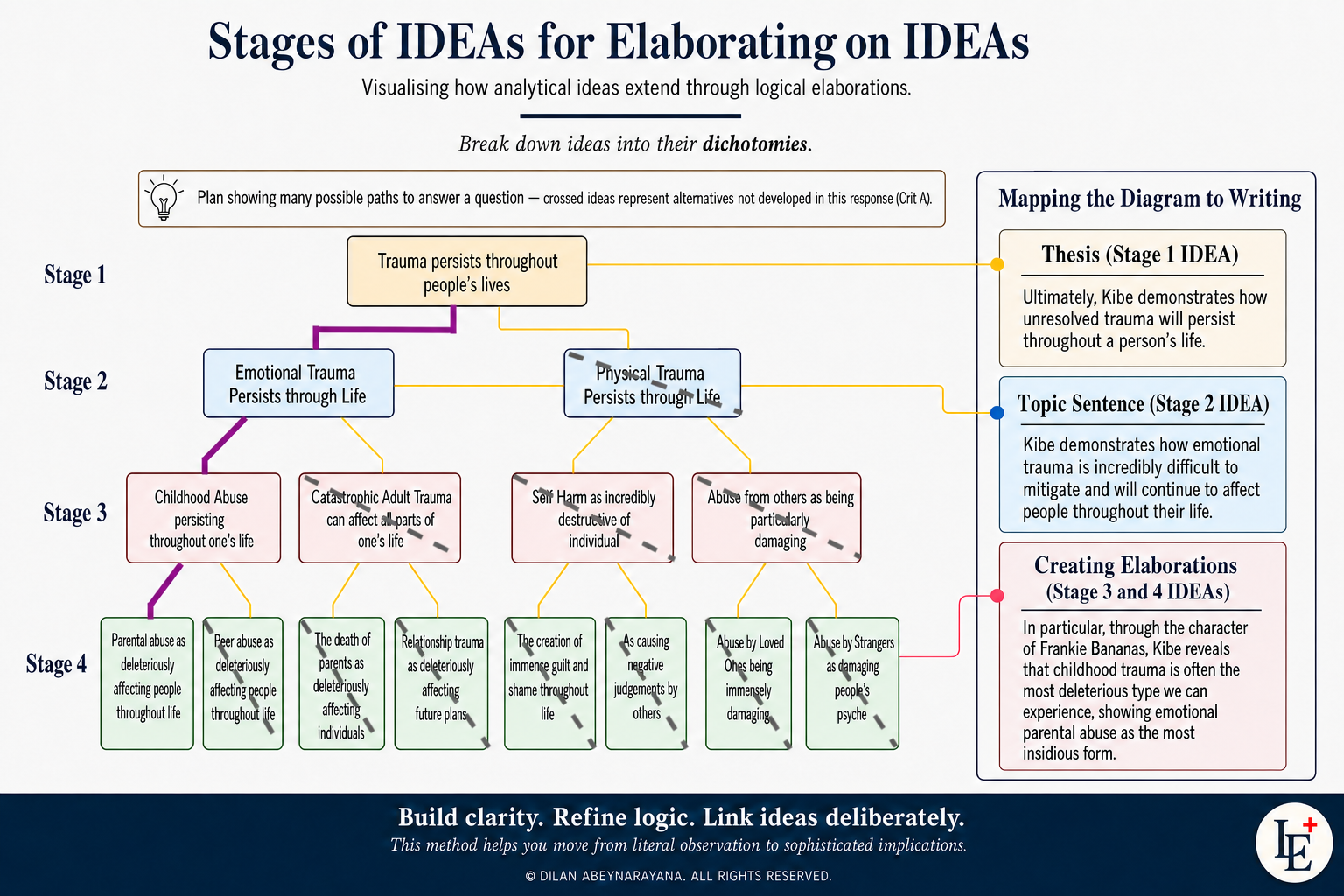
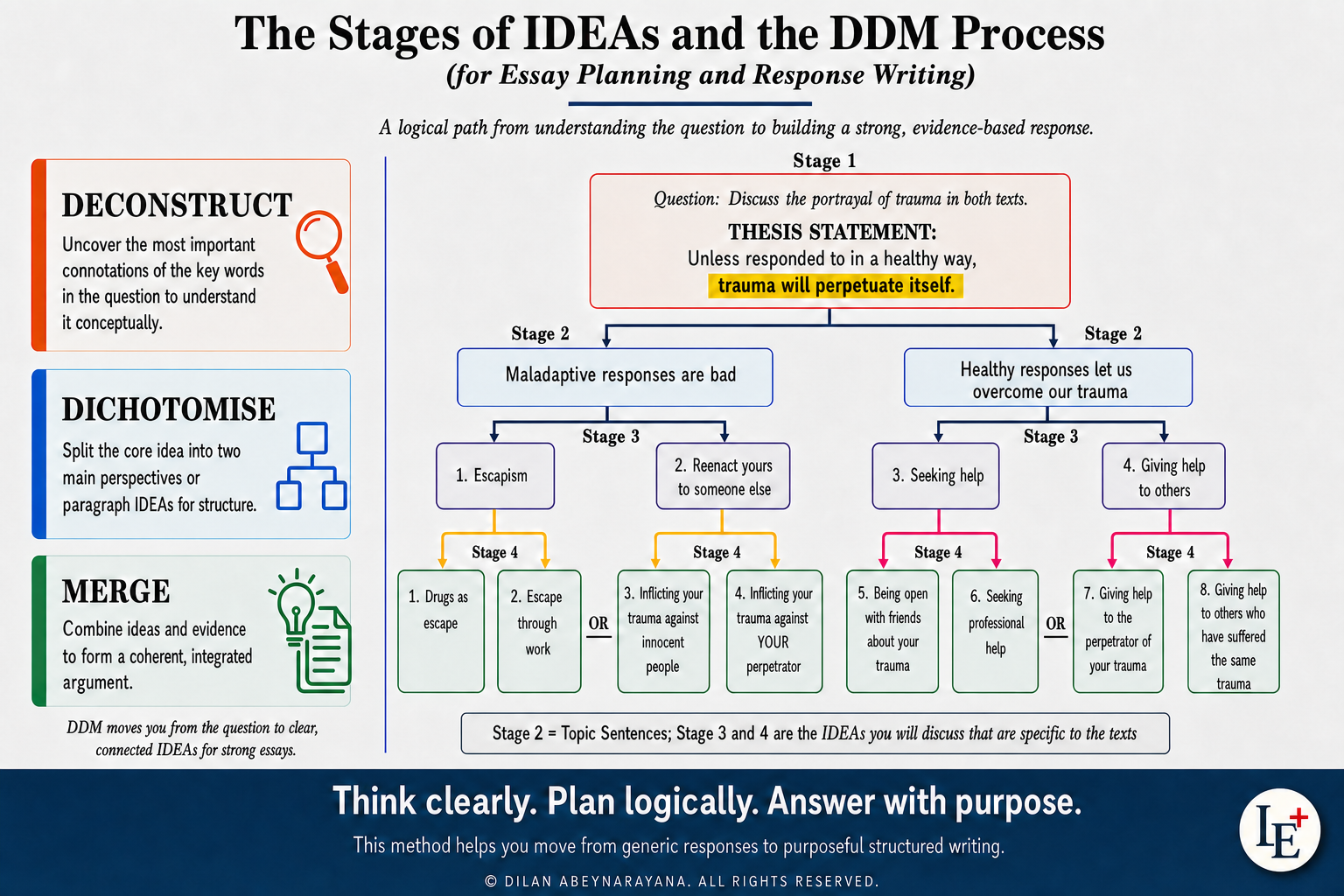
Clarify your strongest IDEAs with Stages of IDEAs.
Combine those IDEAs into a thesis.
Formulate the LOI that thesis answers.
Done
You have planned backwards from your own interpretation.
Your thesis answers the LOI and connects your IDEAs.
Plan backwardsYour strongest IDEAs→Your thesis→The LOI it answers
1. Choose your strongest IDEAs
Return to your classwork and annotations. Choose the main IDEAs you want to discuss because your own analysis supports them. Use Stages of IDEAs to clarify what each argues.
1
2
Further IDEAs or feedback
Get Ready → Do → Done
Get Ready
Use the LOI and thesis agreed in Panel 1.
Return to your own evidence and annotations. Send any completed working or partial notes to the AI below.
Do
State the paragraph IDEA as a Topic Sentence.
Explain its significance, thesis connection and components using Stages of IDEAs.
Deconstruct evidence or key moments to support the IDEA.
Done
Each IDEA contributes to your thesis.
Elaboration develops significance and implications.
Evidence and analysis support that exact IDEA.
LOI + THESIS
Why is that IDEA important/significant?
How exactly does it prove the THESIS?
What is the next, further broken-down stage of your paragraph IDEA? Use it to explain the IDEA’s parts, then break those down again to develop implications.
+ Add evidence
Why is that IDEA important/significant?
How exactly does it prove the THESIS?
What is the next, further broken-down stage of your paragraph IDEA? Use it to explain the IDEA’s parts, then break those down again to develop implications.
+ Add evidence
Get Ready → Do → Done
Get Ready
Read the LOI, thesis and developed IDEAs from Panels 1–2.
Open TEEAL and your own annotations.
Do
Write an introduction that states the thesis.
Develop each IDEA through elaboration and relevant EAs.
Conclude by explaining what the argument has demonstrated.
Done
The essay answers your LOI.
Every paragraph develops the argument.
Ask the AI about one specific planning link or writing decision.
LOI + THESIS
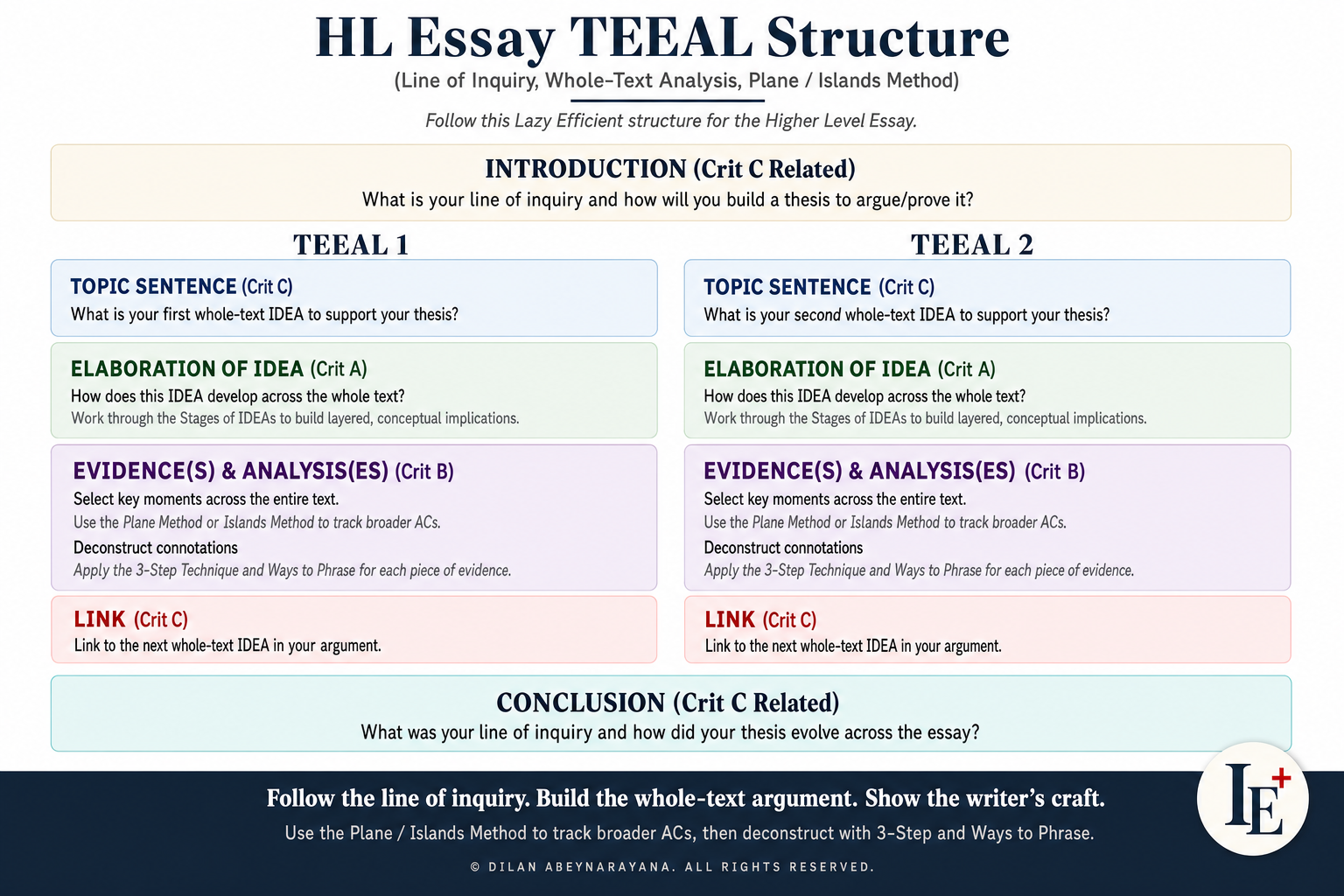
HL Essay scaffold + example
Introduction: See Introduction Writing Guide and Example - HL Essay
Framing Sentence - this will be a more general statement around the essay’s topic in general
Introduction to the texts - this is where you will give the writer’s name and any relevant details about the text itself
Establish the THESIS which answers the question directly - this is where you ACTUALLY answer the question directly. Often you will use words like:
“Ultimately, Writer X argues (links to the words in the question) ….
“It is clear that Writer X believes (links to the words in the question) ….
“Given (links to the words in the question), Writer X claims that ….”
Provide the argument outline - this is where you clearly state HOW you will prove your THESIS by reflecting/rewording the Topic Sentences of your TEEALs
Body Paragraph(s) - TEEAL/IDEA/Argument
Topic Sentence
What is the key IDEA of the argument?
How will it help prove your THESIS?
Elaboration - Moving Through the Stages of IDEAs Guide/Creating ELABORATIONS/DDM/Global Issue Formulation - Criterion A/C
Why is that IDEA important/significant?
How exactly does it prove the THESIS
What is the next, further broken-down stage of your paragraph IDEA? Use it to explain the IDEA’s parts, then break those down again to develop implications.
Evidence
Key quote/section that prove the IDEA
Analysis
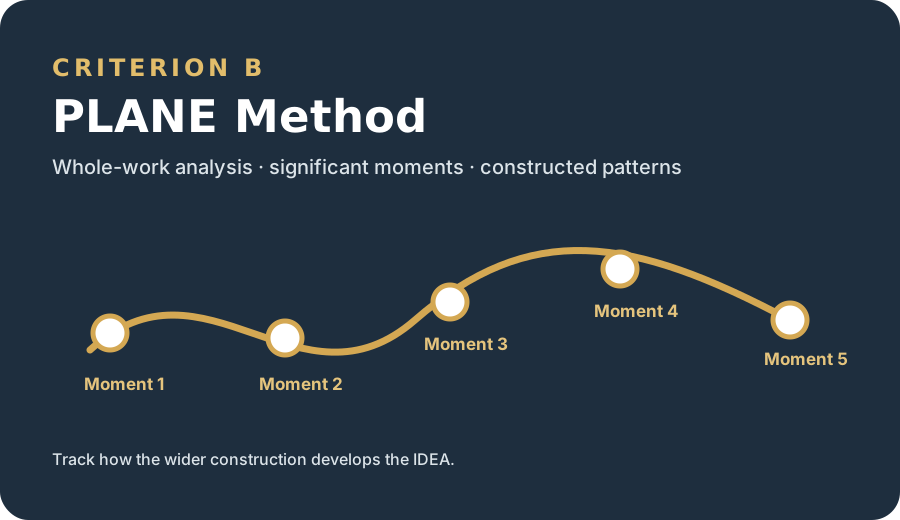
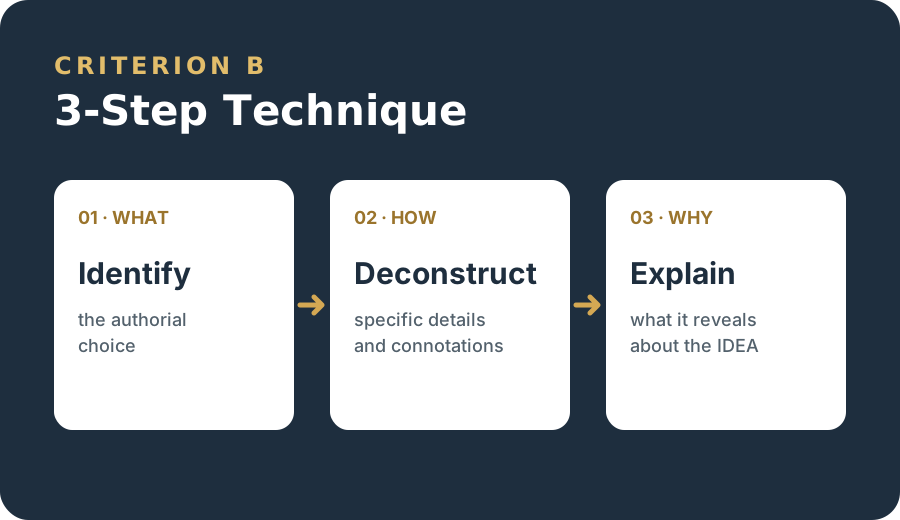
Use the 3-Step or PLANE EA you developed in Stage 2.
Explain how the deconstructed choice develops this paragraph IDEA.
(EA continued)
Linking
What was the key IDEA
How could this key IDEA relate to the next?
Body paragraph 2 · IDEA 2
Conclusion
Reframe the essay’s topic
Clearly restate your THESIS
Outline the IDEAs you used to prove your THESIS
Final comment
Saved draft versions
👨🏫Team Leader Examiner Trained Deliberate Practice L&L AI
AI scope + academic integrity
Why this AI cannot review a full draft
The IB allows teacher advice on the first complete HL Essay draft, without editing or rewriting it. This site reserves full-draft feedback for your teacher. The AI can see your planning and use your draft as context for a specific question; it does not provide a full-draft review or rewrite.
Use only assistance your teacher permits and disclose your AI use. Any AI-generated material included in assessed work must be acknowledged in the text and bibliography. Keep your process record for teacher review. The site’s full-review restriction is a teaching boundary; it is not a claim that every AI interaction counts as a formal IB feedback round.