Paper 2 Deliberate Practice Lab

Build the essay in four clear stages.
Choose the part you need. Your work carries forward automatically.
Build ONE argument from the question
First work out exactly what the question means. Then create the single argument that will control the whole essay.
What you do
- Deconstruct: break down the important wording and useful connotations.
- Dichotomise: find a meaningful Side A / Side B tension.
- Merge: turn that tension into a thesis using both works.
What good looks like
- You are answering the exact question, including qualifiers.
- Both works can genuinely prove both sides.
- Your thesis is an argument, not a topic description.
Use these resources
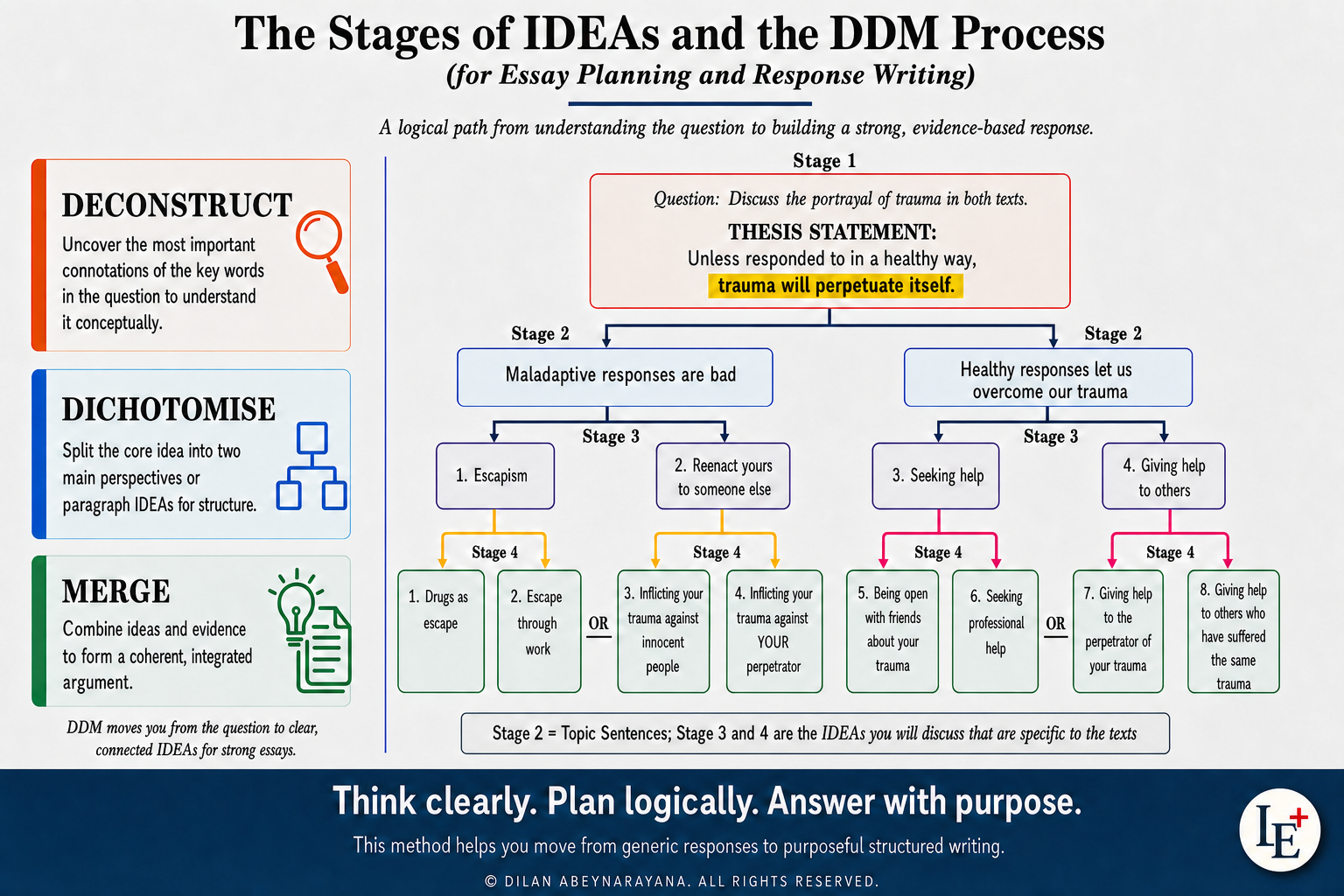
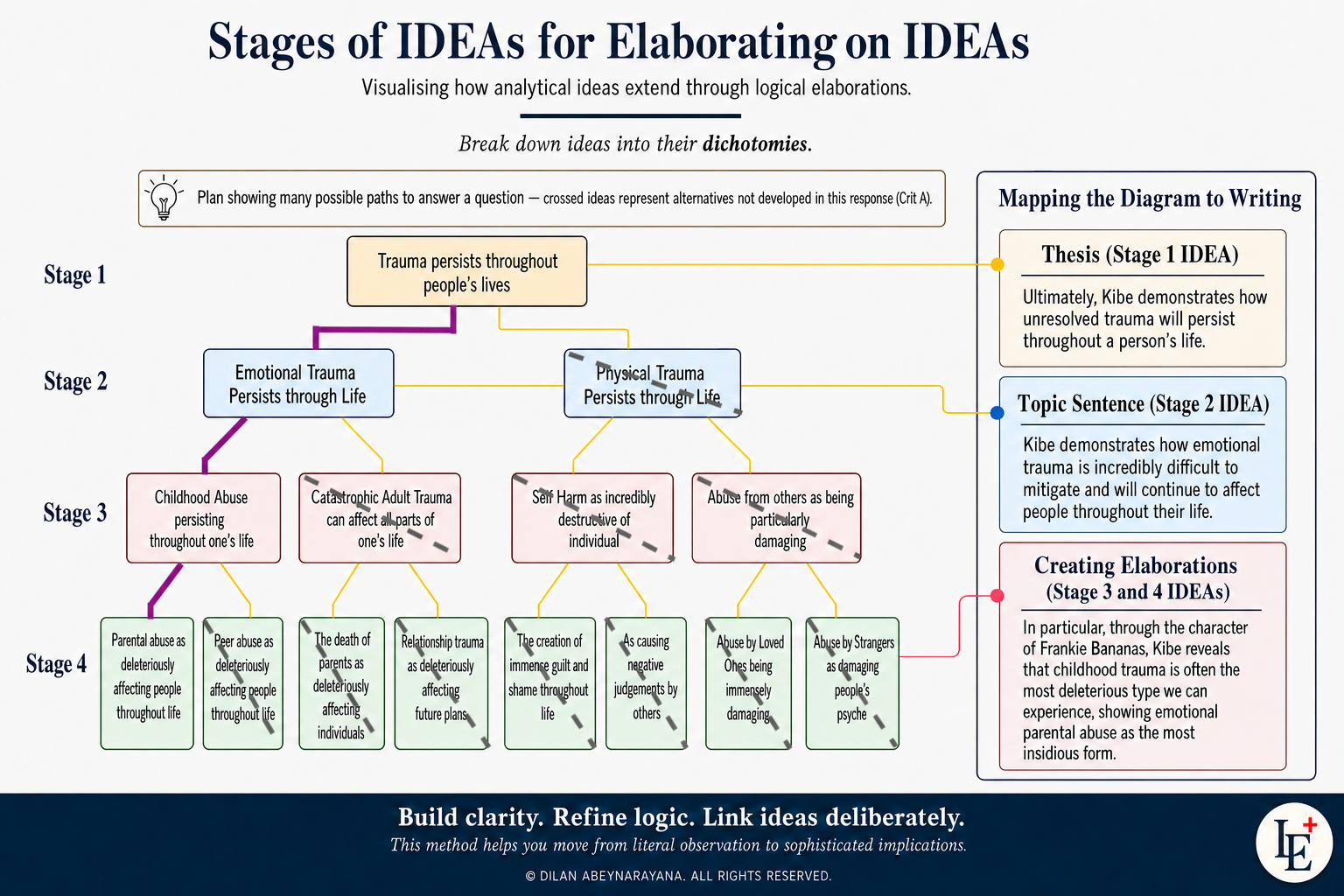
1. Deconstruct non-negotiable
Identify the important question term(s). Generate useful connotations, not dictionary definitions. Explore enough possibilities to find what links meaningfully to the studied works.
2. Dichotomise non-negotiable
Use the deconstruction to generate possible divisions. Then choose ONE dichotomy that is useful for both studied works and can structure the essay.
3. Merge non-negotiable
Connect the chosen dichotomy to the IDEAs you already know from both works. Merge both sides into a thesis that answers the exact wording of the question.
Find evidence that genuinely compares
You already have the argument. Now find the strongest authorial-choice journey in both works that proves it.
What you do
- Choose the same broader authorial choice in both works.
- Track meaningful movement across several moments in Text 1 and Text 2.
- Write the direct comparison in purple.
- Decide whether the comparison proves Side A, Side B, or neither.
Colour key
- Red = Text 1
- Blue = Text 2
- Purple = the actual comparison
- The goal is not three random examples. It is a journey/pattern across the works.
Use these resources
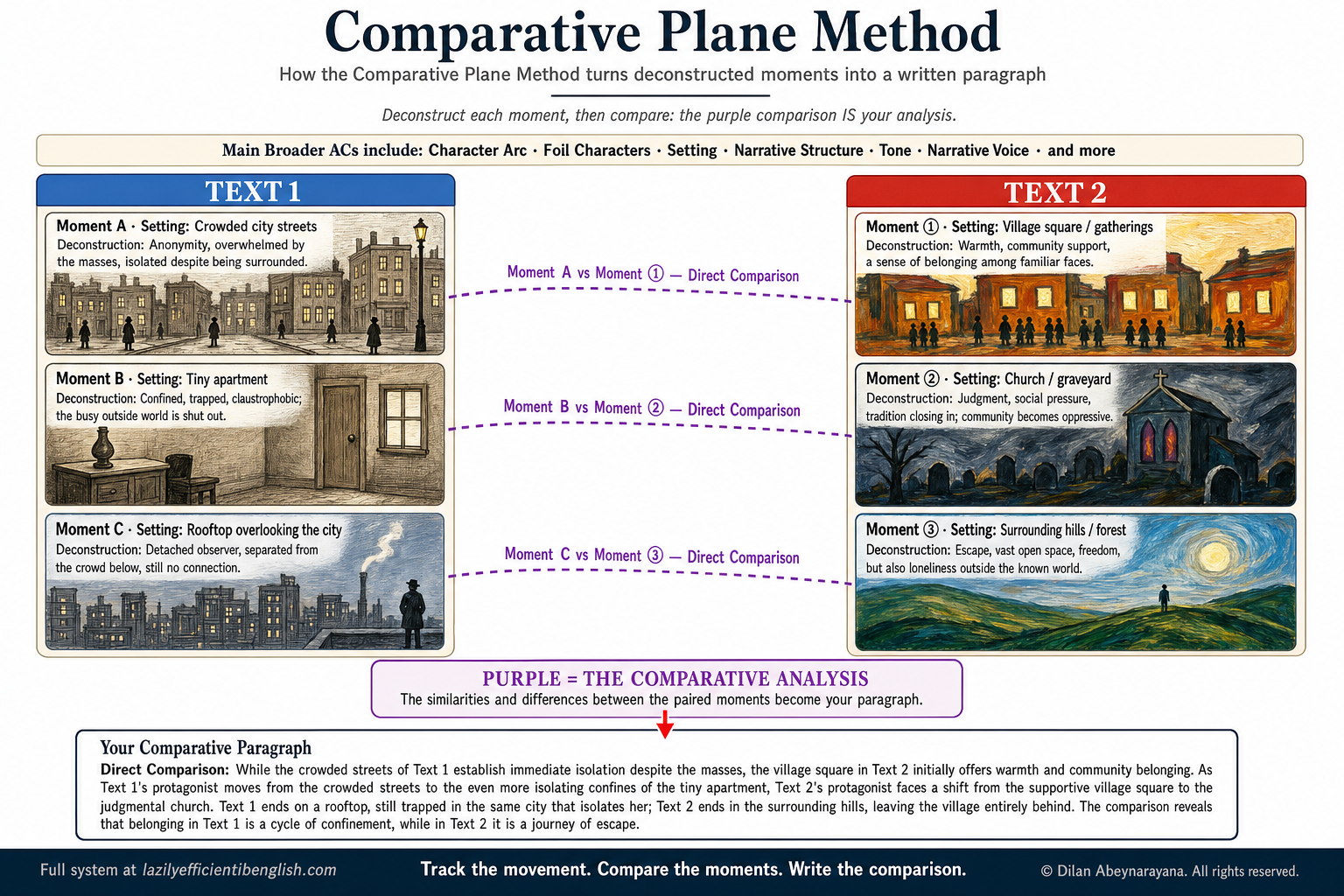 Broader AC movement across both texts
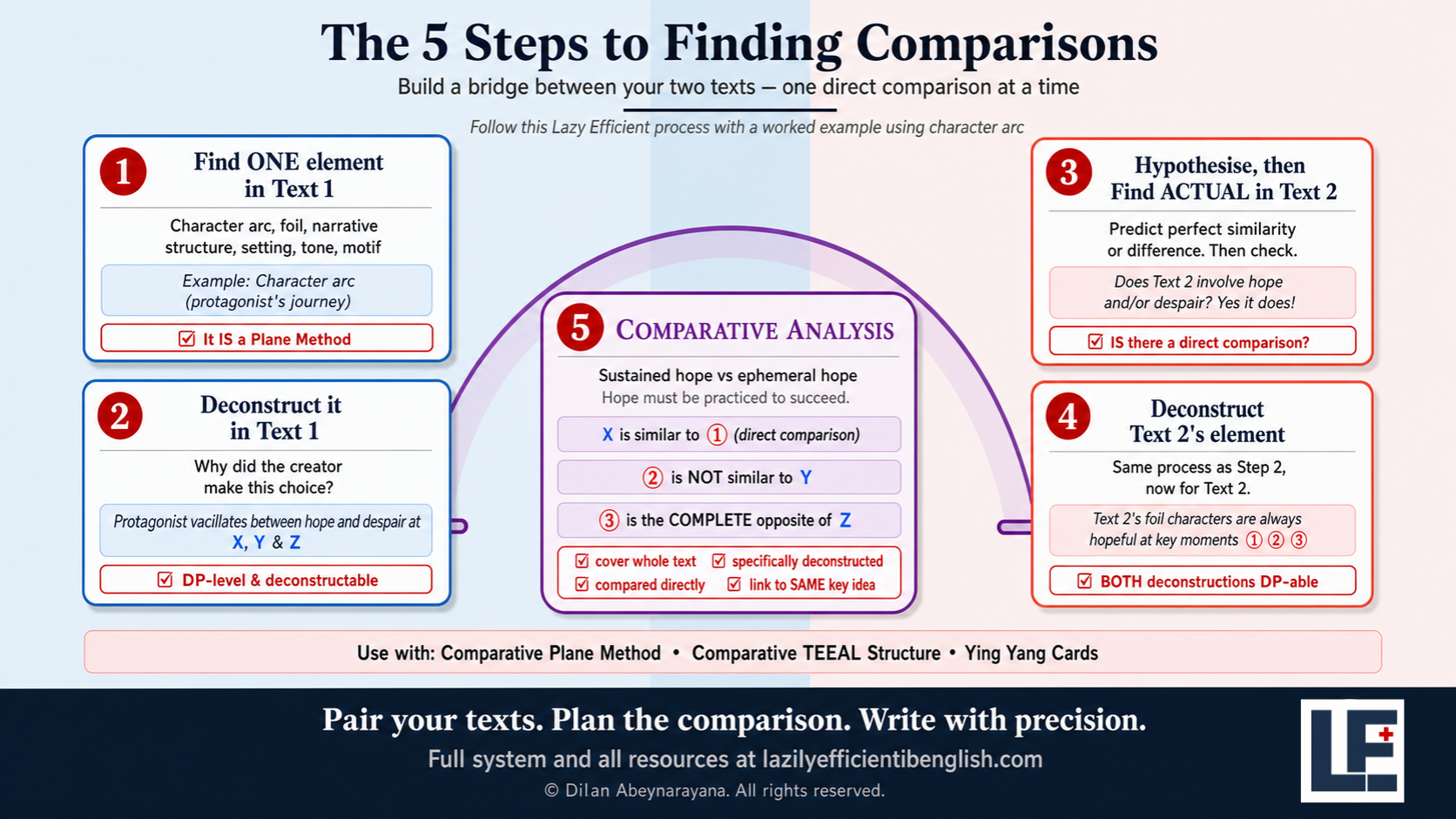 Find → deconstruct → hypothesise → match → compare
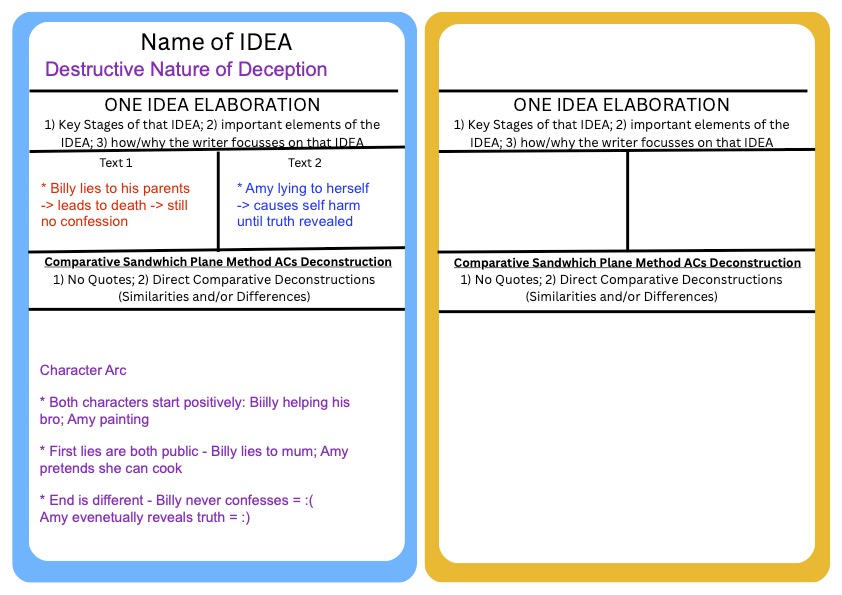 Text 1 specifics + Text 2 specifics + purple comparison
| 🔴 Text 1 — specific moment | 🔵 Text 2 — corresponding moment | 🟣 Direct comparison |
|---|---|---|
| 🔴 Text 1 — specific moment | 🔵 Text 2 — corresponding moment | 🟣 Direct comparison |
|---|---|---|
| 🔴 Text 1 — specific moment | 🔵 Text 2 — corresponding moment | 🟣 Direct comparison |
|---|---|---|
Build the essay before you write it
Your DDM and strongest PLANE comparisons are ready. Now organise them into a clear comparative essay plan.
What you do
- Use the DDM to build the introduction.
- Use Side A as the basis of TEEAL 1 and Side B as the basis of TEEAL 2.
- Develop the IDEA in ELAB before using authorial-choice evidence.
- Insert only your strongest comparative PLANE material.
Keep the sections separate
- TS: conceptual claim
- ELAB: explain/break down the IDEA
- EA: specific PLANE evidence + deconstruction
- Purple comparison: what the texts reveal when compared
Use these resources
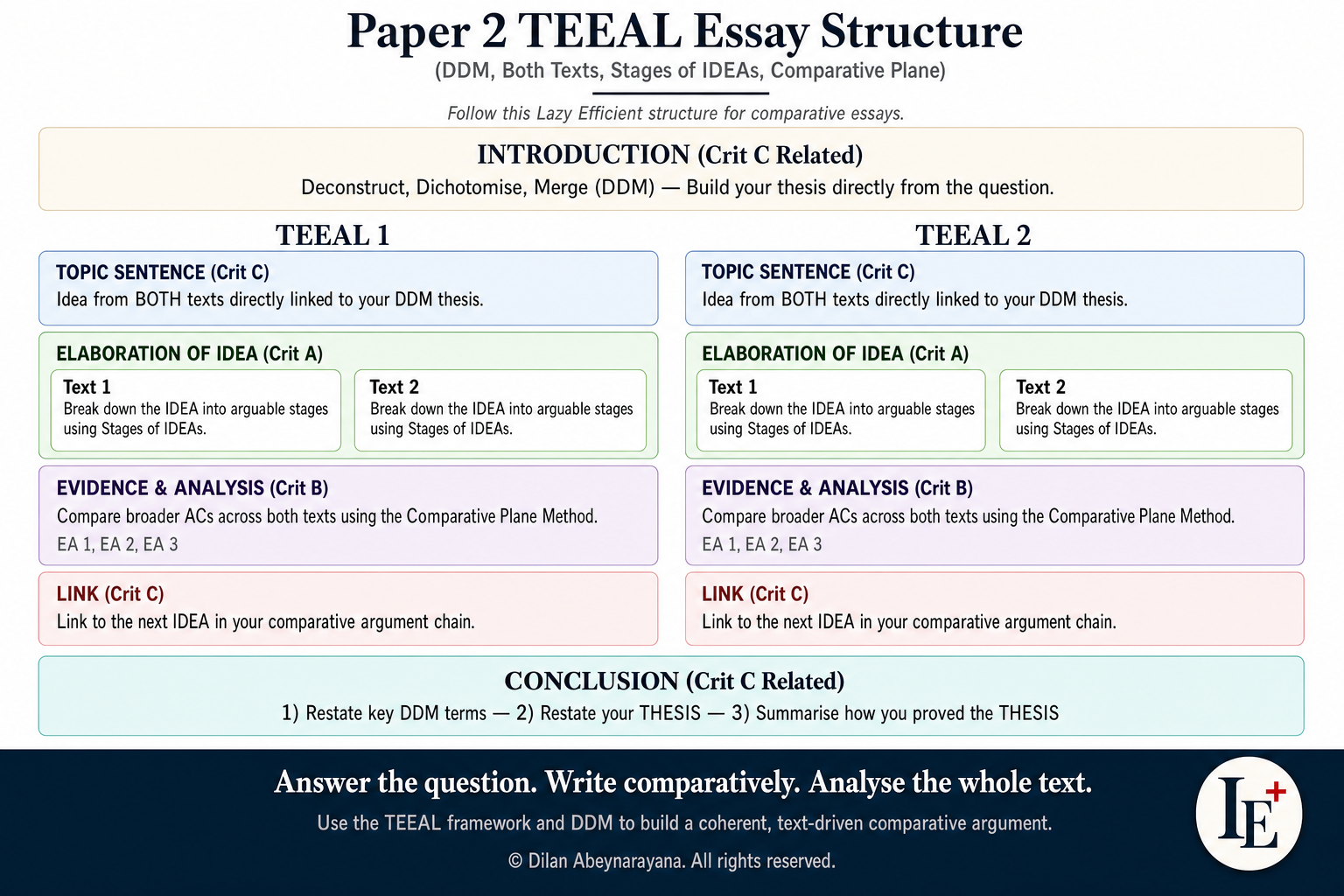
DDM to use in the Introduction
- Deconstruction: Not completed yet.
- Dichotomy: Not completed yet.
- Merge / Thesis: Not completed yet.
TEEAL 1 — prove Side A of the main dichotomy
TEEAL 2 — prove Side B of the main dichotomy
Write the complete Paper 2 response
The thinking is already done. Write independently from the plan, then use the feedback to improve the next version.
While writing
- Keep the exact question and DDM visible.
- Follow the plan instead of inventing new ideas halfway through.
- Position evidence clearly enough for a marker to understand its significance.
- Compare directly rather than writing two separate mini-essays.
What the feedback checks
- A: understanding, accuracy, relevance to the question
- B: analysis of authorial choices and comparison
- C: focus, organisation and development
- D: language, clarity and register
Use these resources
Movement across whole works · direct comparison · effect on the IDEA