








🔥 Try an Activity

See all →
IB Paper 1 activity – A Radical Opinion on ChatGPTM24 TZ2

"A Radical Opinion on ChatGPT"

DICE/PACT, IDEAs, cloze, timed EAs

Open →
IB Paper 1 activity – Indian Soul FoodM21

"Indian Soul Food"

DICE/PACT, IDEAs, timed writing

Open →
IB Paper 1 activity – Infinities of Being A HousewifeN21

"Infinities of Being A Housewife"

Annotation, IDEAs, timed analysis

Open →
IB Paper 1 activity – Humour at WorkN21

"Humour at Work"

Annotation, IDEAs, timed analysis

Open →
IB Paper 1 activity – Bulgaria Bike BlogM22

"Bulgaria Bike Blog"

IDEAs tree, timed analysis, essay

Open →
IB Paper 1 activity – The Art of EatingM23

"The Art of Eating"

Annotation, IDEAs, essay practice

Open →
IB Paper 1 activity – Nat Geo Effects of Climate ChangeM22

"Nat Geo Effects of Climate Change"

Crit A, B, C exercises

Open →
📄 N22 Paper 1 - Ode to Cauliflower
← Back to Paper 1

✧ Crit A: DICE / IDEAs / Elaboration | Crit B: Click annotations to analyse

📂 DICE/PACT
DICE/PACTDICE/PACT
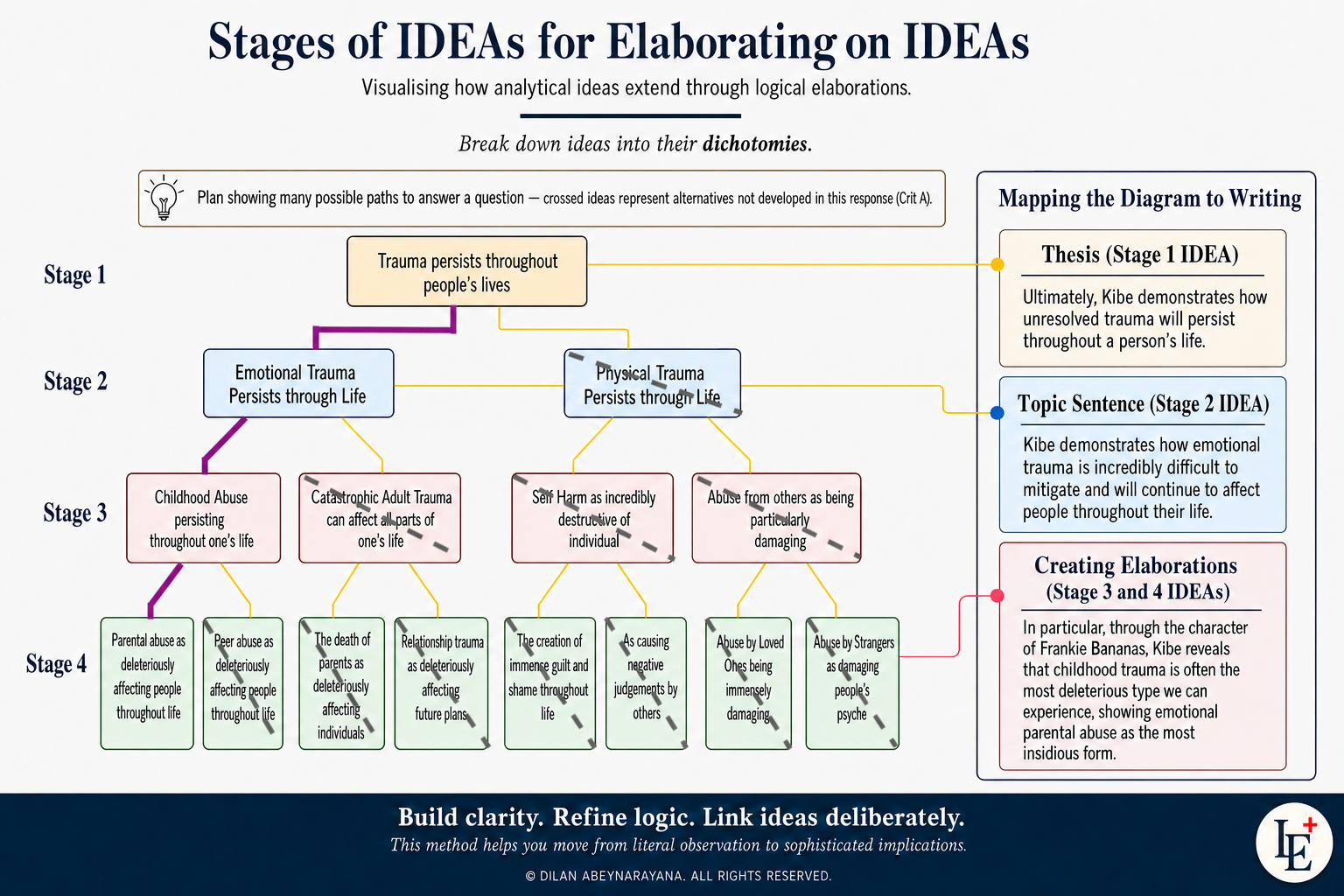
📂 Stages of IDEAs
Stages of IDEAsStages of IDEAs
📂 TEEAL scaffold
Paper 1 TEEALTEEAL scaffold
📂 TS & ELAB
TS & ELABTS & ELAB

Ode to Cauliflower

If you love this nutrient-rich veggie, you might appreciate the evolutionary effort that created it.
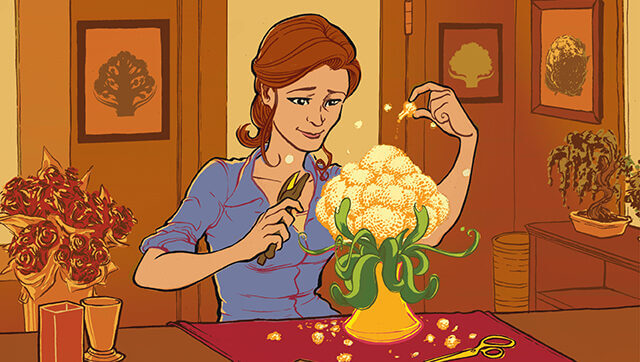
Illustration of woman holding cauliflower
Illustration by Paul Hostetler

Now that cauliflower has earned superstar veggie status (available dark-roasted in all the fancy restaurants or minced as low-carb “rice” in all the hip health-food bistros), I come before you with amazing news: That bumpy cauliflower head? It’s actually a bunch of flowers!

Or rather, it’s a mass of tiny unopened flower buds, harvested before they could blossom. Flower buds! When you serve cauliflower rice, you’re spooning up a bouquet. When you baste a whole head of cauliflower and set it in the middle of the table, golden as a Thanksgiving turkey, it’s like feasting on a roasted rose.

OK, not exactly. Roses are from the family Rosaceae, and they have lots of petals. Cauliflowers are from the Cruciferae family — the word “cruciferous” refers to a cross, as these plants’ tiny flowers have four petals arranged in a simple X.

Other cruciferous vegetables — which are also known by yet another Latin name, Brassicaceae — include all the cabbages, as well as the mustards, broccolis, and radishes. (We usually eat only the roots of radishes, so how would we know the plants flower into Xs? But they do — or they would, if we didn’t eat their roots before their flowers had a chance to bloom.)

And even more amazingly, when we eat our beloved cauliflower, we’re not just eating flower buds: We’re eating mutant flower buds! It’s a minor miracle that they exist at all.

The Humble Mutant

Thousands of years ago, the original cabbage, Brassica oleracea, grew wild throughout Europe, from the British Isles to Greece. At some point, our ancestors went from foraging these wild plants (which look a bit like mustard greens) to harvesting seeds and planting them in gardens.

Then, on what I like to imagine was a fine sunny day on the island of Rhodes — that part of Greece that’s just offshore from Turkey — something happened. Maybe it was a bumblebee that did it, buzzing from one cruciferous garden vegetable with a recessive gene to another cruciferous garden vegetable with a recessive gene. Anyway, somehow these two odd genes met and grew into the mutant cruciferous garden vegetable we call the cauliflower.

Imagine being the first gardener to see that come up. What a crazy-looking vegetable! You’d invite everyone in the village over to take a look. “You don’t see that every day!” you’d boast, full of bewilderment and pride.

Cultivated cauliflower slowly spread west from Rhodes. It made it to Italy next, but didn’t find its way to France until sometime in the 1500s. In the definitive agricultural textbook of 1600, Théâtre de l’agriculture, author Olivier de Serres referred to the plant as cauli-fiori — floral cabbage. (If etymology excites you, you’ll notice that the “caul” sound at the front of the word is similar to what you hear in “collards,” “kohlrabi,” and “colcannon” — a dish made of cabbage and mashed potatoes — as well as “coleslaw.” Kohl is German for “cabbage.”)

An Honest Miracle

Here in the 21st century, seemingly everything is a miracle. Every time I turn around, a new protein powder or antioxidant bar shows up on my desk, invariably containing proprietary ingredients and enough marketing hype to make you believe it is a modern marvel.

But, in fact, we are surrounded by honest miracles that no one markets because no one owns them. Cauliflower and other whole foods are miracles that we inherited from nameless, ancient souls. Maybe it was a laughing woman who sang to her plants while her eyes caught every vital detail of their growth. Maybe it was a quiet man with bulging knuckles and a memory for past weather.

All I know is that we have inherited miracles. In cauliflower, we received a miracle of flavor, a miracle of health, and a miracle of botany. Mediterranean mutant flower-bud clusters — delicious roasted, sautéed, riced, or puréed! If that doesn’t make you want to eat your veggies, I don’t know what will.

And if you happen to be the one making the roasted cauliflower for Thanksgiving this year, please take a moment as you cut into it to give thanks for the great chain of circumstances that made something so bizarre and difficult and wonderful also so common.

📌 Guiding question: How and to what effect are diction and imagery used in this text?

Fill in the table. The two PACT details are:

  • Text Type / Audience: Experience Life is a lifestyle magazine dealing with home/lifestyle issues, largely female audience.
  • Context: 2014 – a focus on whole foods / health foods.
DICE PieceYour INFERENCECONFIRMING EVIDENCE
Date: November 14, 2014
Text Type: Lifestyle magazine article / food writing

Note: Break down the argument into its conceptual parts.

Stage 0/1 IDEA
Problem
Solution/Implications
Aspect A
PACT/DICE
Aspect B
PACT/DICE
Aspect C
PACT/DICE
Aspect D
PACT/DICE

Write a topic sentence with a clear IDEA. Then elaborate integrating PACT. Click "Check My Elaboration" for banded feedback – you can cycle through example sets.

Topic Sentence:

Elaboration:

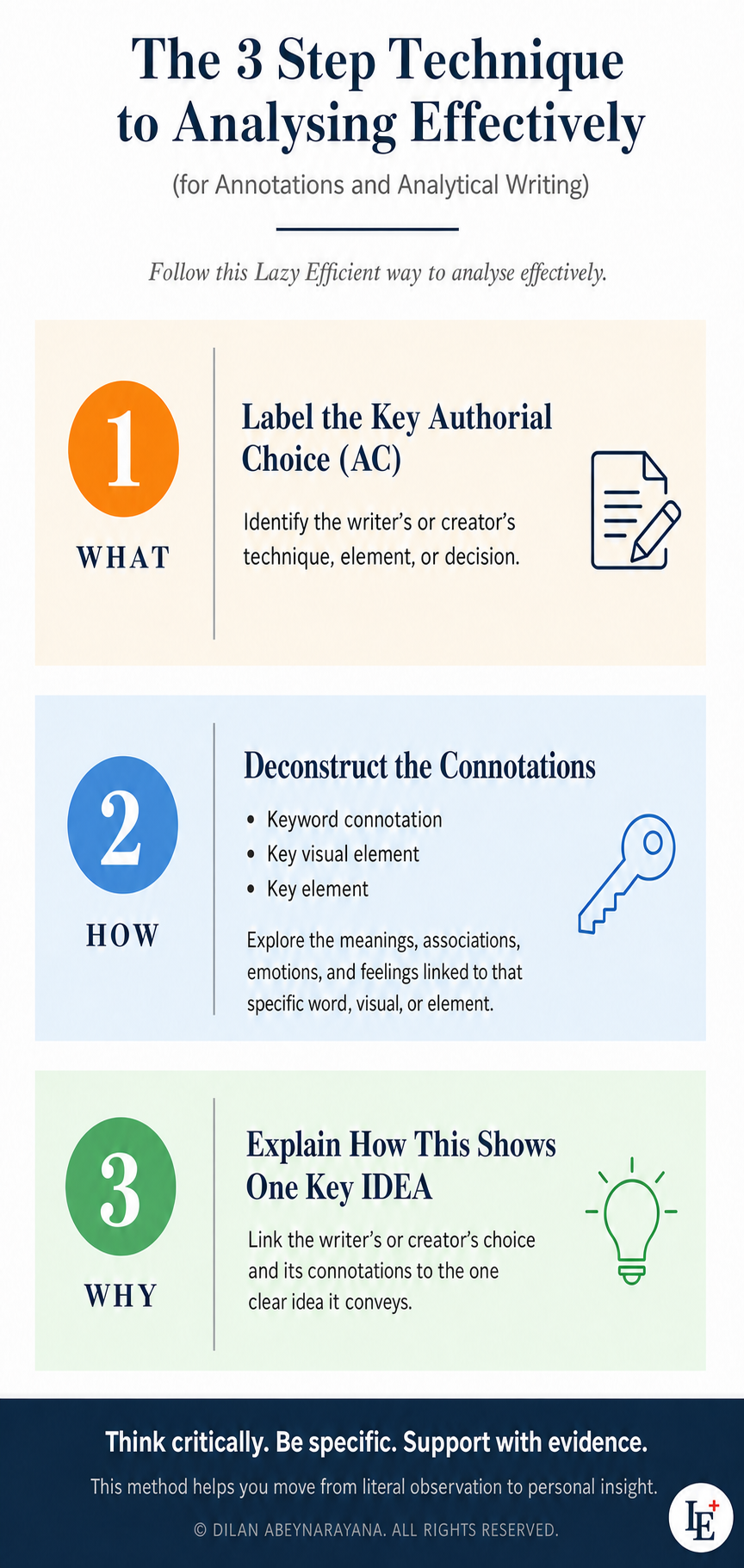
📂 3‑Step Technique
3‑Step Technique3‑Step Technique
📂 Annotation Rubric
Annotation RubricAnnotation Rubric
📂 TEEAL scaffold
Paper 1 TEEALTEEAL scaffold
📂 Ways to Phrase Deconstructions
Ways to PhraseWays to Phrase Deconstructions

Click any highlighted phrase or visual element. Write your AC, Decon, IDEA. Click Reveal to see the model answers.

Ode to Cauliflower

If you love this nutrient-rich veggie, you might appreciate the evolutionary effort that created it.
Woman holding cauliflower
🎨 warm orange pastel background · 👀 devoted gaze · ✋ delicate hand position · 🖼️ framed paintings · 🌹 rose and bonsai motifs

Now that cauliflower has earned superstar veggie status (available dark-roasted in all the fancy restaurants or minced as low-carb “rice” in all the hip health-food bistros), I come before you with amazing news: That bumpy cauliflower head? It’s actually a bunch of flowers!

Or rather, it’s a mass of tiny unopened flower buds, harvested before they could blossom. Flower buds! When you serve cauliflower rice, you’re spooning up a bouquet. When you baste a whole head of cauliflower and set it in the middle of the table, golden as a Thanksgiving turkey, it’s like feasting on a roasted rose.

OK, not exactly. Roses are from the family Rosaceae, and they have lots of petals. Cauliflowers are from the Cruciferae family — the word “cruciferous” refers to a cross, as these plants’ tiny flowers have four petals arranged in a simple X.

Other cruciferous vegetables — which are also known by yet another Latin name, Brassicaceae — include all the cabbages, as well as the mustards, broccolis, and radishes. (We usually eat only the roots of radishes, so how would we know the plants flower into Xs? But they do — or they would, if we didn’t eat their roots before their flowers had a chance to bloom.)

And even more amazingly, when we eat our beloved cauliflower, we’re not just eating flower buds: We’re eating mutant flower buds! It’s a minor miracle that they exist at all.

The Humble Mutant

Thousands of years ago, the original cabbage, Brassica oleracea, grew wild throughout Europe, from the British Isles to Greece. At some point, our ancestors went from foraging these wild plants (which look a bit like mustard greens) to harvesting seeds and planting them in gardens.

Then, on what I like to imagine was a fine sunny day on the island of Rhodes — that part of Greece that’s just offshore from Turkey — something happened. Maybe it was a bumblebee that did it, buzzing from one cruciferous garden vegetable with a recessive gene to another cruciferous garden vegetable with a recessive gene. Anyway, somehow these two odd genes met and grew into the mutant cruciferous garden vegetable we call the cauliflower.

Imagine being the first gardener to see that come up. What a crazy-looking vegetable! You’d invite everyone in the village over to take a look. “You don’t see that every day!” you’d boast, full of bewilderment and pride.

Cultivated cauliflower slowly spread west from Rhodes. It made it to Italy next, but didn’t find its way to France until sometime in the 1500s. In the definitive agricultural textbook of 1600, Théâtre de l’agriculture, author Olivier de Serres referred to the plant as cauli-fiori — floral cabbage. (If etymology excites you, you’ll notice that the “caul” sound at the front of the word is similar to what you hear in “collards,” “kohlrabi,” and “colcannon” — a dish made of cabbage and mashed potatoes — as well as “coleslaw.” Kohl is German for “cabbage.”)

An Honest Miracle

Here in the 21st century, seemingly everything is a miracle. Every time I turn around, a new protein powder or antioxidant bar shows up on my desk, invariably containing proprietary ingredients and enough marketing hype to make you believe it is a modern marvel.

But, in fact, we are surrounded by honest miracles that no one markets because no one owns them. Cauliflower and other whole foods are miracles that we inherited from nameless, ancient souls. Maybe it was a laughing woman who sang to her plants while her eyes caught every vital detail of their growth. Maybe it was a quiet man with bulging knuckles and a memory for past weather.

All I know is that we have inherited miracles. In cauliflower, we received a miracle of flavor, a miracle of health, and a miracle of botany. Mediterranean mutant flower-bud clusters — delicious roasted, sautéed, riced, or puréed! If that doesn’t make you want to eat your veggies, I don’t know what will.

And if you happen to be the one making the roasted cauliflower for Thanksgiving this year, please take a moment as you cut into it to give thanks for the great chain of circumstances that made something so bizarre and difficult and wonderful also so common.
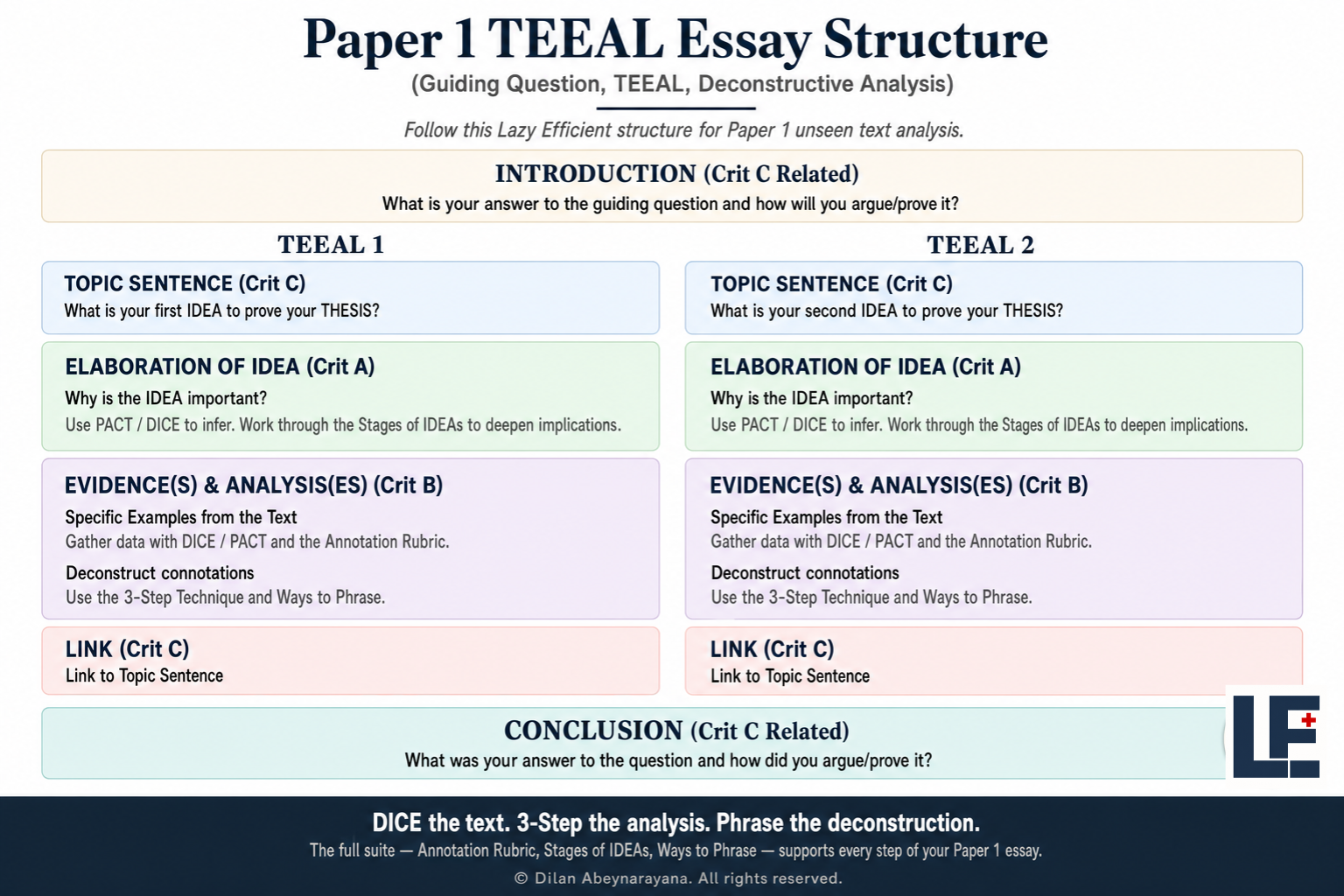
📌 Guiding question: How and to what effect are diction and imagery used in this text?

Rank the top 5 annotations. For each, explain why it allows high-level analysis.

RankAnnotation / WordWhy high‑level?
1
2
3
4
5

Write a full EA. Click "Check My EA" to get a score and see full band tables (you can cycle through example sets).

5 minutes

3 minutes

1 minute

Essay Plan

Full Essay