

🔥 Try an Activity

See all →
IB Paper 1 activity – Indian Soul FoodM21

"Indian Soul Food"

DICE/PACT, IDEAs, timed writing

Open →
IB Paper 1 activity – Infinities of Being A HousewifeN21

"Infinities of Being A Housewife"

Annotation, IDEAs, timed analysis

Open →
IB Paper 1 activity – Humour at WorkN21

"Humour at Work"

Annotation, IDEAs, timed analysis

Open →
IB Paper 1 activity – Bulgaria Bike BlogM22

"Bulgaria Bike Blog"

IDEAs tree, timed analysis, essay

Open →
IB Paper 1 activity – The Art of EatingM23

"The Art of Eating"

Annotation, IDEAs, essay practice

Open →
IB Paper 1 activity – Nat Geo Effects of Climate ChangeM22

"Nat Geo Effects of Climate Change"

Crit A, B, C exercises

Open →
IB Paper 1 activity – Ode to CauliflowersN22

"Ode to Cauliflowers"

Annotation, IDEAs, essay practice

Open →
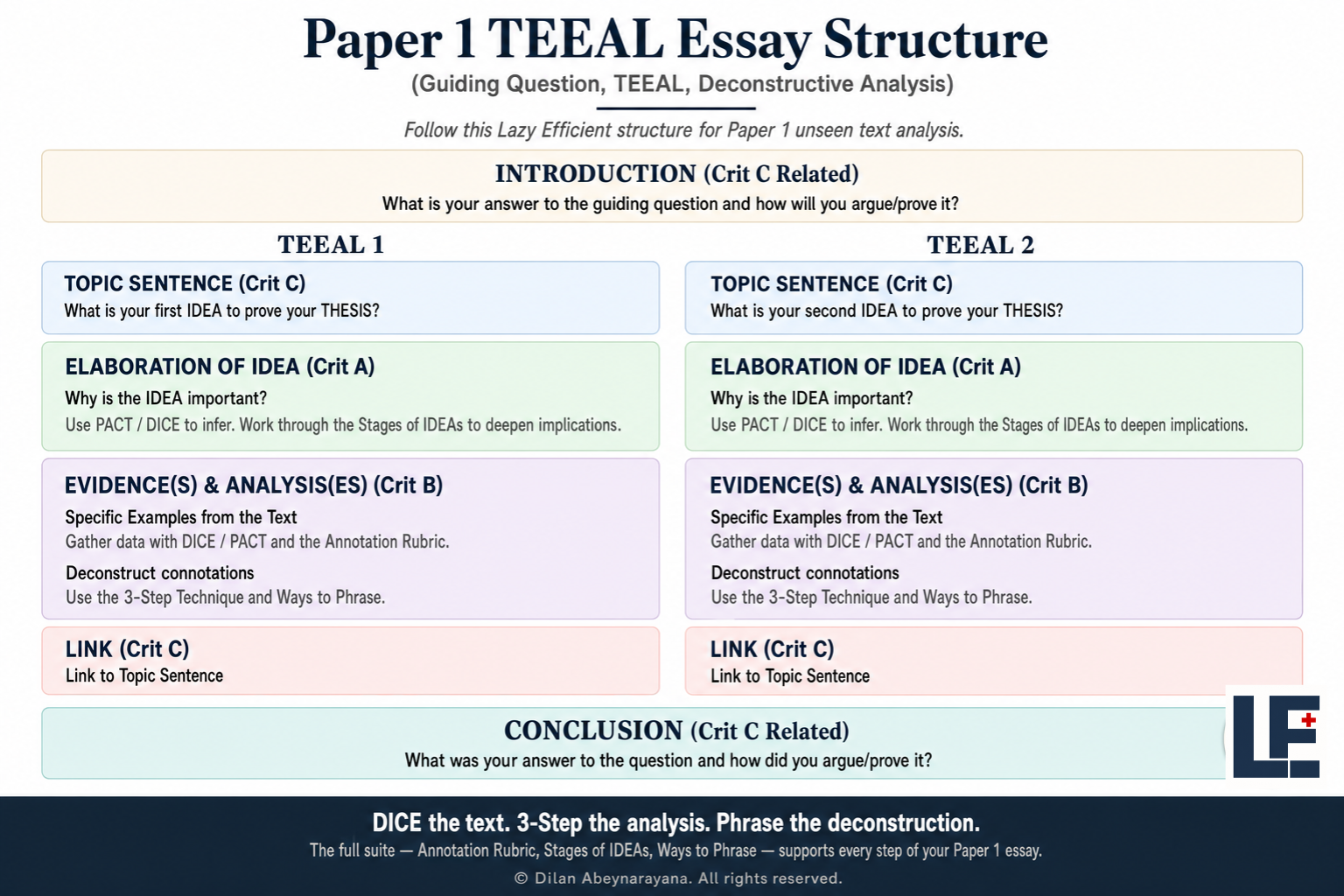
Paper 1 TEEAL Structure 📄 Paper 1 PACT/DICE Activity – click image to download
← Back to all Paper 1 resources
📘 TEEAL Structure TEEAL Structure
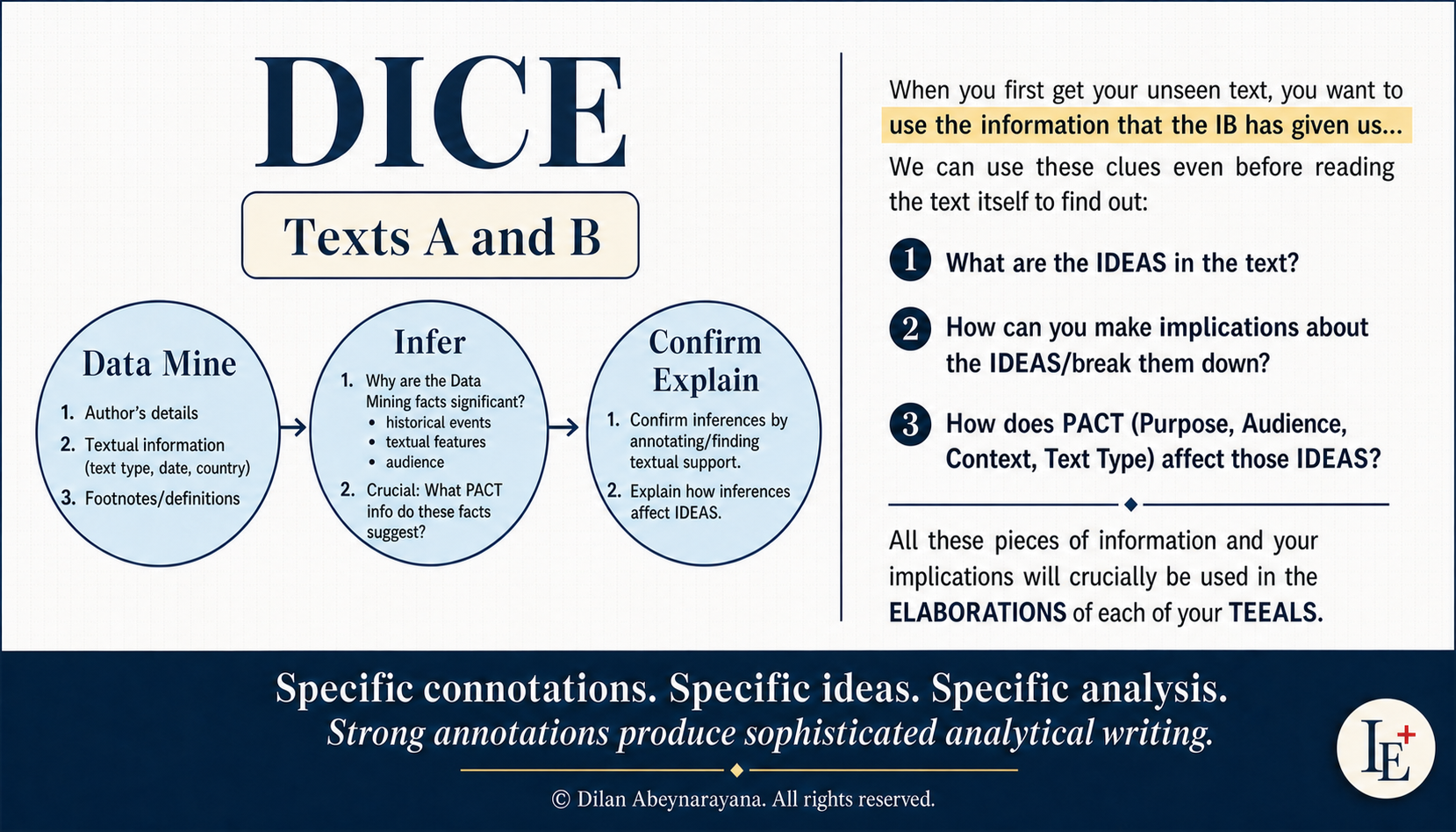
🎲 DICE / PACT DICE / PACT
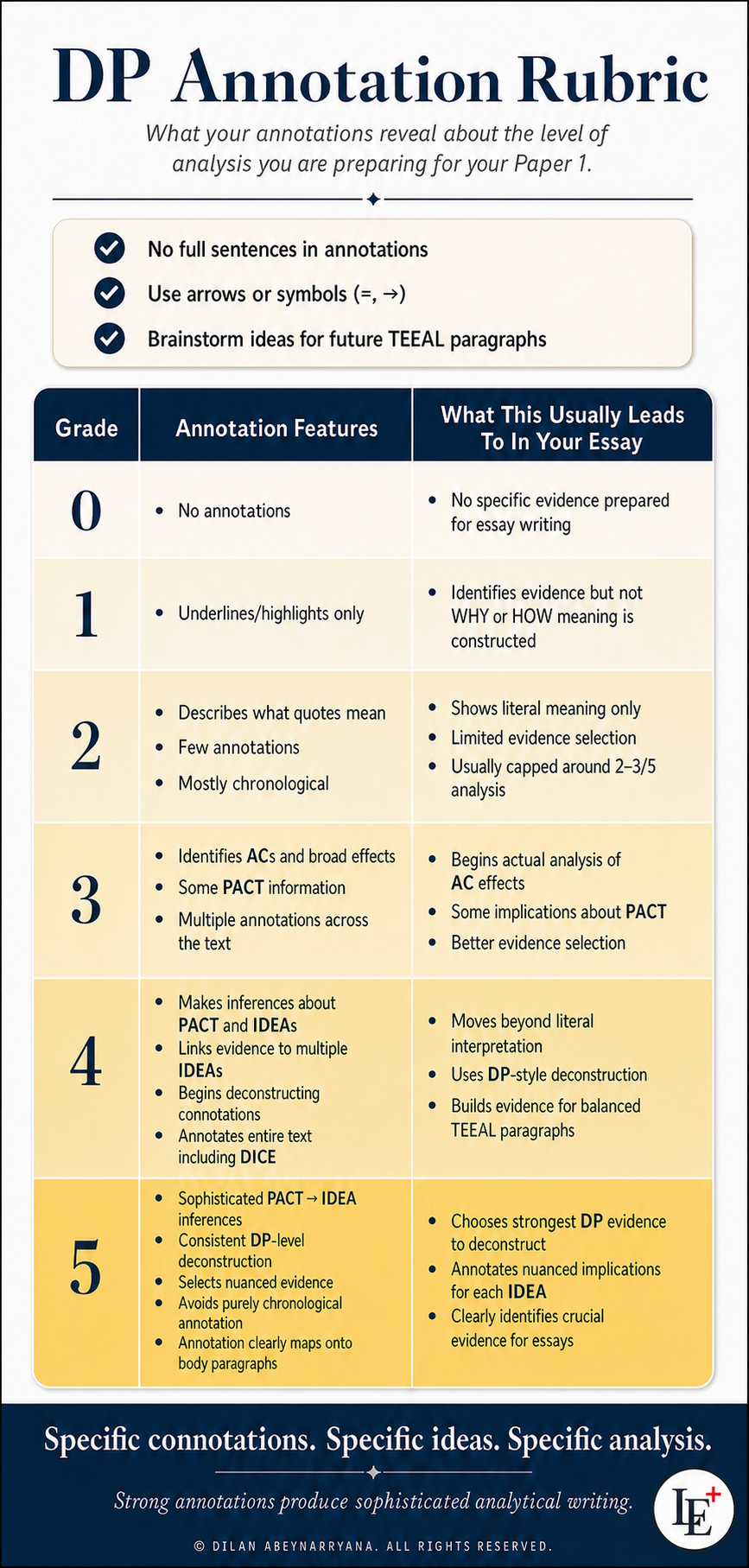
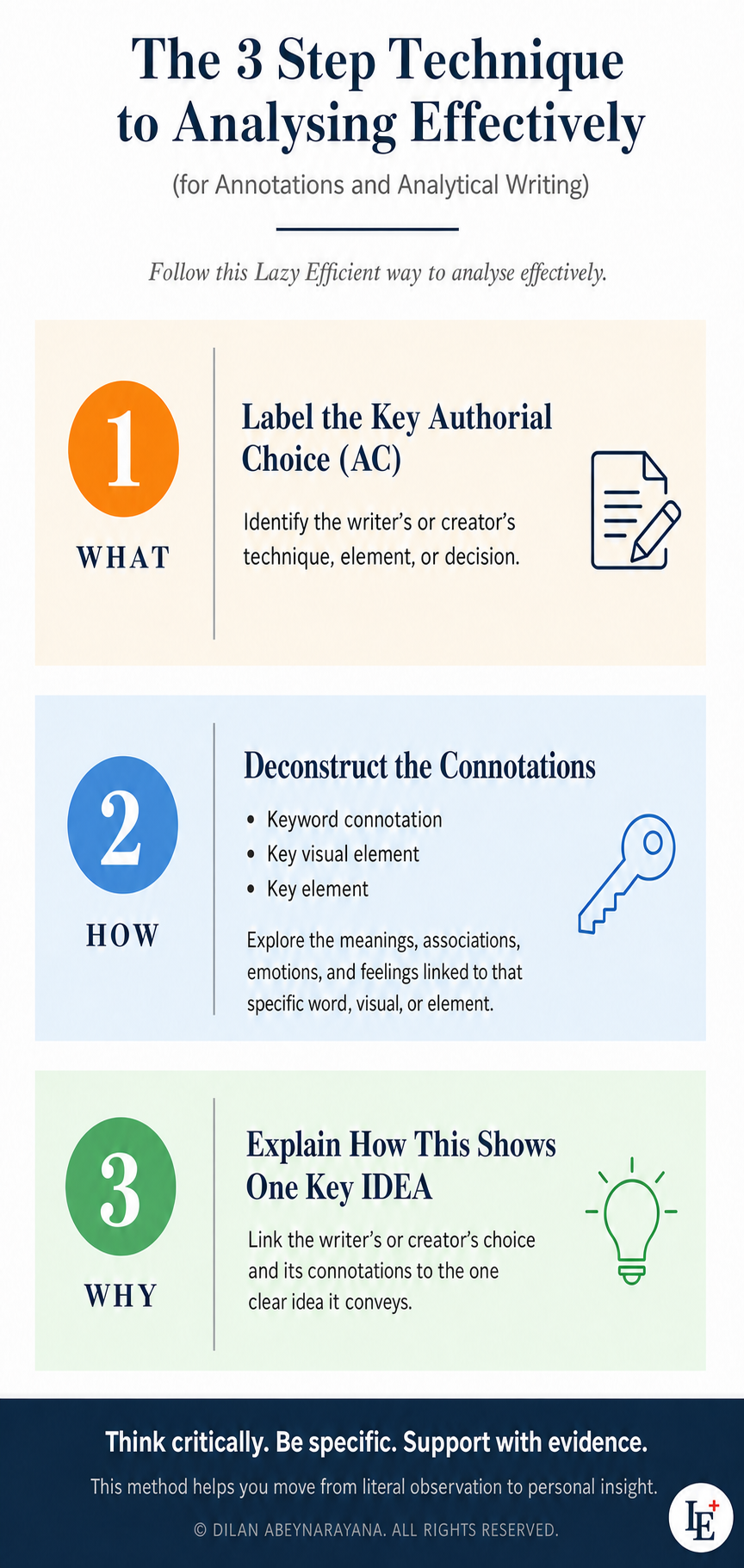
📌 3‑Step Annotation 3-Step Annotation
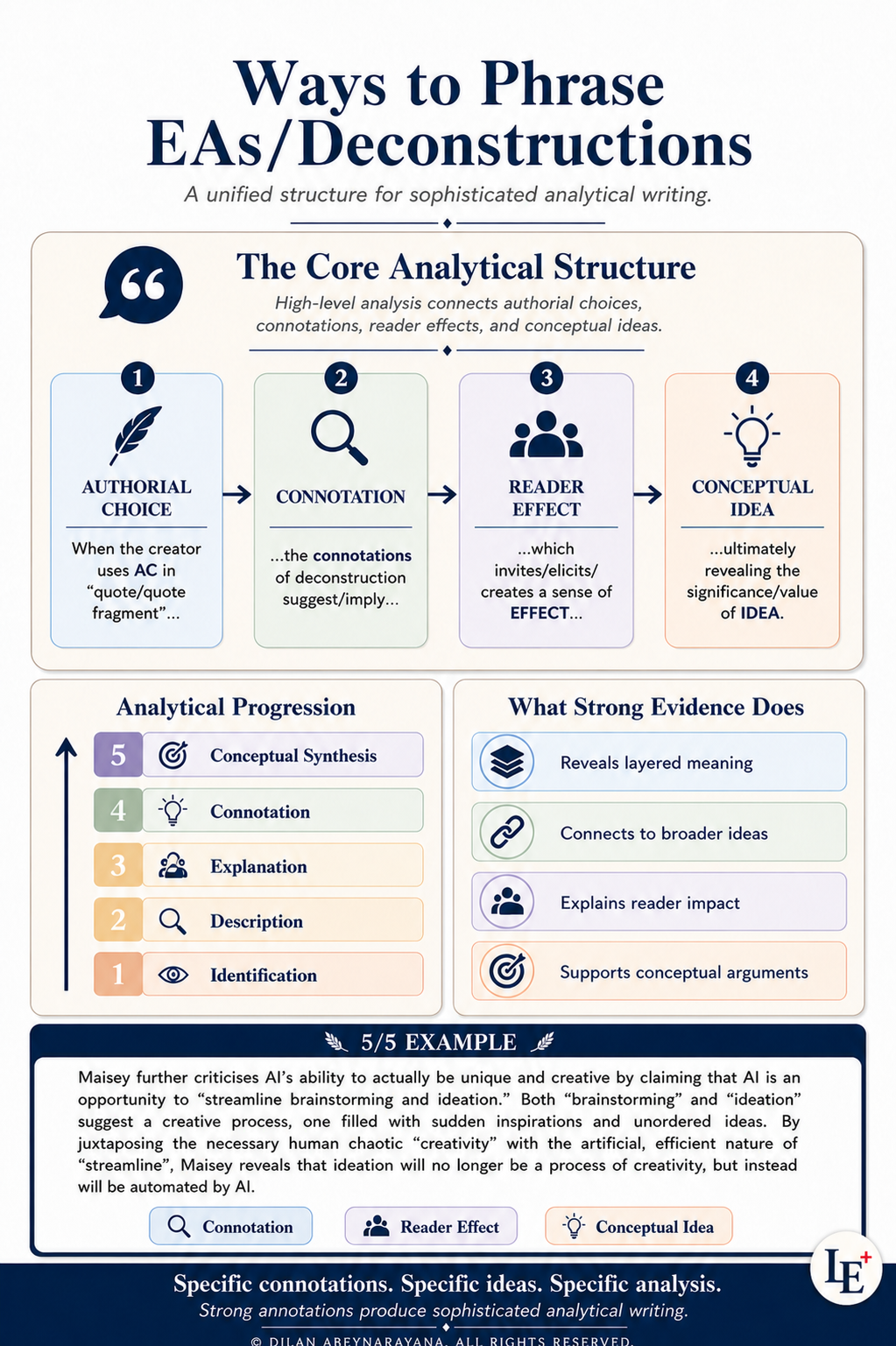
✍️ Ways to Phrase Ways to Phrase Deconstructions

✧ Find a Criterion to focus on; do the tasks; check your responses against the examples

📖 How to use this page

For the following activities, use your feedback to target the specific skills you want to improve. These do not have to be done in order but instead should be based on the key skills you need to improve. They should be done in concert with the guides in the Paper 1 page.

Note 1: You will see the tasks plus ways to self assess (often by comparing to "answers"). Note: as this is L&L there are multiple valid interpretations.

Note 2: When doing the All Criterion tasks, you can compare to example responses from high to low – though as always there is always a chance of uncertainty in L&L marking.

1

Read & Guess

Read the article below. Type your guesses into the red dashed boxes (missing DICE/PACT info).

2

Toggle Reveal

Click "Reveal Answers" to check your guesses. Hover any resource to preview it.

3

Complete Exercises

Use the revealed DICE/PACT info to complete the 4 Accordions below (Crit A, B, C, All Crit).

Exercise: DICE → Inference → Evidence

What to do: For each DICE piece listed below, write an inference explaining how/why it is relevant to your IDEAs. Then, find a quote from the article that confirms your inference.

Guiding Question (GQ): How does the writer structure this article to present the argument?

A radical opinion on ChatGPT

Churn out every idea and then burn it down.
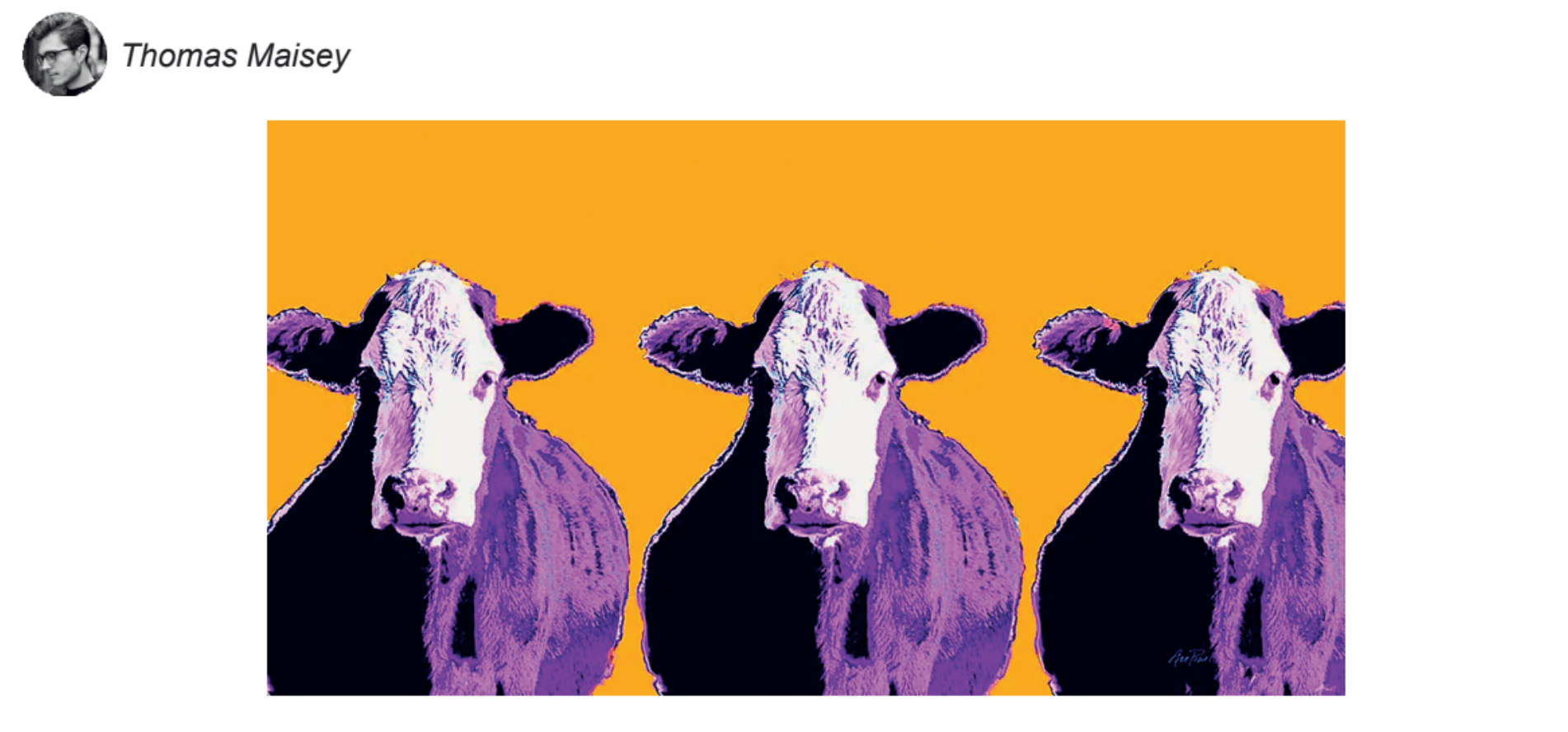
Three purple cows in a row facing head on. Set on a mustard background.

We need to talk about ChatGPT. Actually, not just ChatGPT but all AI-powered content development tools. Whether it's text-to-image AIs, or those capable of generating conversational text, computer code, poetry, and more in response to prompts.

Artificial Intelligence has been chipping at creatives for a while, and this technological transformation is going to create as many opportunities as it does headaches for various sectors.

Discussions online so far have focused on embracing it wholesale or resisting the intrusion of AI into day-to-day work. But I think so far, a lot of the judgment have focused too much on saving time, money, and resource.

Instead, we should shift our thinking to see this as a problem of originality. A challenge to get back to being remarkable. An opportunity to streamline brainstorming and ideation. To hold a mirror up to ourselves and ask — is this really what I want to put out there?

Let me explain why by recapping how AI and Machine Learning work.

Machine Learning In A Nutshell

One of the most common forms of Artificial intelligence (AI) is Machine Learning which teaches computers to think in a similar way to how humans do. Essentially, it takes a massive set of data and processes it to spot patterns in the data that can be used to predicate the outcome of future similar cases.

It's Machine Learning that's powering ChatGPT as it's received tonnes of training data to be able to churn out impressive predictive content in response to our text prompts. In fact, when most companies today use AI, they are most likely using Machine Learning. Think about how Netflix or Disney+ will suggest content to you that gets more and more accurate over time. Or even how social media feeds for decades have retained your attention with tailored recommendations. Prediction engines are powerful.

Why Creative Machine Learning Should Shake Us

When I played around with ChatGPT I was both impressed and saddened. Right away I thought of this passage from Orwell…

Never use a metaphor, simile, or other figures of speech that you are used to seeing in print. — George Orwell

When Orwell penned this in Why I Write he was capturing an idea, a point of view on what it means to push yourself to be original in a crowded space. And the discipline it requires over time to keep yourself that way.

It's the same idea, expressed in a different context, that Seth Godin put forward in Purple Cow. And as I've said before every communicator wants to be remarkable, otherwise, you are not worth remembering. And if you're not remembered, your identity is lost and the value of your user experience is zero.

See, ChatGPT will be a threat to being remarkable and original if it's not embraced in a radical way. Because it's trained on commonplace content — on massive amounts of data which hold patterns that can be read and predicated. That means if it's churning out a fundraising email, brand mission statement or film script — it's opting for the common and unremarkable. It's our job, our challenge, to push beyond that and be unpredictable.

Getting Radical with ChatGPT

When I talk about seeing this rise in AI as a challenge to get back to being remarkable, I envision several ways to seize this opportunity to streamline ideation.

  • Churn out every idea and then burn it down: Embrace head on, churn out as many concepts as ChatGPT can provide you. Review them, and understand the common points. Then use none of it. Throw it away. Challenge ourselves to produce work that looks nothing like that at all and listen to no one that does.
  • Find a place for the content and park it there: Use it for the drumbeat content, the everyday products you need to fill space in your workflow. But be strict, limit the unremarkableness it churns out to say 30% of your output. Once you park its usage in that area of your workflow, you can free up your time and energy to go beyond the common in the bigger areas you focus on.

These are just two radical starting points in the call to view the rise of Machine Learning content as a way to hold a mirror up to ourselves as creators. If you can think of other ways to embrace the call and use these capabilities to push beyond the predictable and into the remarkable please share in the comments below!
Disclaimer: This article was originally published in , an online newsletter and blog that helps designers think more critically about their work, particularly in the area of user experience (UX).

DICE Piece (from article)Your INFERENCE (how/why relevant to IDEAs)CONFIRMING EVIDENCE (quote from article)
Author: Thomas Maisey
Date: Dec 15, 2022
Publication: UX Collective
Text Type: Online opinion piece

Self-Assessment: Which pieces of PACT were most useful to answering the GQ? How able were you to add implications to the literal meaning of the text? Did you manage to include DICE information explicitly?

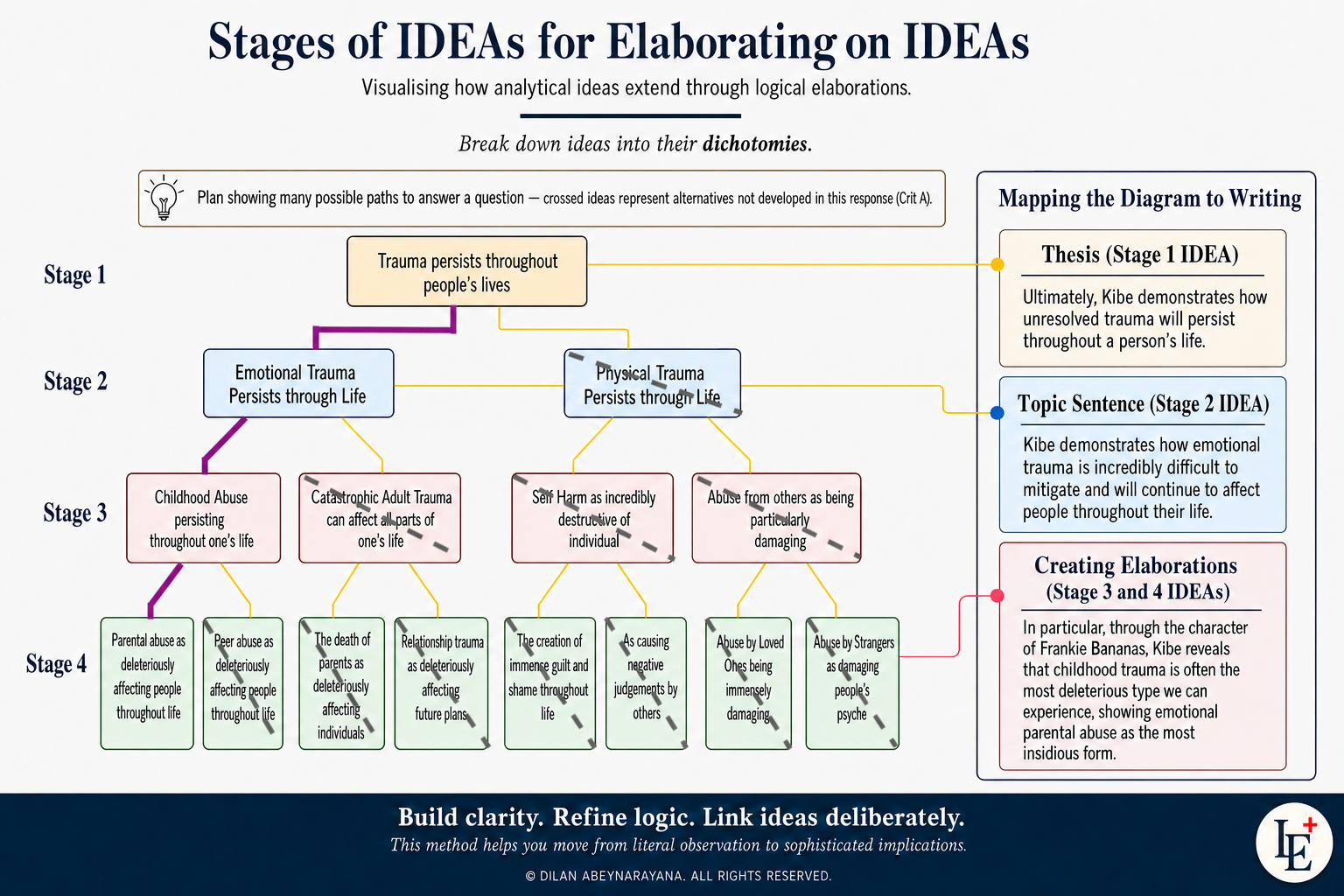
Crit A: Stages of IDEAs (Tree Diagram)

Note for Crit A and Crit C: Most students only focus on the AC part of guiding questions and ignore the conceptual second part. In this case, if we keep the question the same (though we can always change it), we do need to talk about structure. But we also need to address the concept: "to present the argument".

Stage 0 IDEA: "The writer uses structure" or "The writer uses structure to present an argument" – this says nothing and earns very little for Crit A and C. We need to move beyond that by breaking down the argument into its parts. We can then use the Stages of IDEAs to do this. Below you can break it down – when you press "Check My Response" we can give you some feedback about its qualities.

Stage 0 / Stage 1 IDEA

The writer's central message/structure

Structure Branch 1: Presenting the Problem
Structure Branch 2: Presenting the Solution
Problem Aspect A
PACT / DICE Details
Problem Aspect B
PACT / DICE Details
Solution Aspect A
PACT / DICE Details
Solution Aspect B
PACT / DICE Details

Self-Assessment: Which stage are you currently working at? What do you need to do to move to the next stage?

Topic Sentence and Elaboration Writing

How to use your Stages of IDEAs to craft a Topic Sentence and Elaboration:

  • Topic Sentence: Identify the key IDEA from your Stage 1/2/3. How does it help answer the Guiding Question?
  • Elaboration: Integrate PACT (Purpose + Audience) to explain the IDEA. Note: Quote integration could occur here, even if those quotes aren't analysed completely.

Write your Topic Sentence and Elaboration here:

Topic Sentence:

Elaboration (Integrate PACT + Purpose + Audience):

Note: These tasks use the same article as Crit A, but they focus on different skills. You haven't seen the specific word choices we've removed here before, so you will be working purely from the annotations provided.

Crit B: Analysis and Evaluation – Deconstruction of Connotations & Effects

Three purple cows in a row facing head on. Set on a mustard background.

A radical opinion on ChatGPT

Churn out every idea and then AC: metaphor
Decon: aggressively destructive
it down.

We need to talk about ChatGPT. Actually, not just ChatGPT but all AI-powered content development tools. Artificial Intelligence has been AC: metaphor
Decon: negative; gradual but incessant
at creatives for a while, and this technological transformation is going to create as many opportunities as it does AC: tactile imagery
Decon: minor but incessant irritation/pain
for various sectors.

Discussions online so far have focused on embracing it wholesale or resisting the intrusion of AI into day-to-day work. But I think a lot of the judgment has focused too much on saving time, money, and resources.

Instead, we should shift our thinking to see this as a problem of originality. A challenge to get back to being AC: diction
Decon: innately human; immensely creative
. An opportunity to streamline brainstorming and ideation. To hold a AC: metaphor
Decon: self-reflective
up to ourselves and ask – is this really what I want to put out there?

Machine Learning in a AC: metaphor
Decon: simplified to only important features

One of the most common forms of AI is Machine Learning, which teaches computers to think in a similar way to how humans do. Essentially, it takes a massive set of data and processes it to spot patterns in the data that can be used to predict the outcome of future similar cases.

It's Machine Learning that's powering ChatGPT as it's received AC: high modality diction
Decon: immensity
of training data to be able to AC: tactile imagery / part of a lexical field of automation
Decon: thoughtless mass production
out impressive predictive content in response to our text prompts. In fact, when most companies today use AI, they are most likely using Machine Learning. Think about how streaming services and social media feeds retain AC: pronoun
Decon: creating a personalised 'stake' in the topic
attention with tailored recommendations. Prediction engines are powerful.

Why Creative Machine Learning Should Shake Us

When I AC: diction (two words)
Decon: cursory engagement; lacking real expertise
with ChatGPT I was both impressed and AC: juxtaposition
Decon: duality of promise vs threat
.

Never use a metaphor, simile, or other figures of speech that you are used to seeing in print. — George Orwell

When Orwell penned this in his essay 'Why I Write', he was capturing an idea, a point of view on what it means to push yourself to be original in a AC: metaphor
Decon: oversaturated; difficult to stand out
space. And the AC: diction
Decon: human effort; focus
it requires over time to keep yourself that way.

It's the same idea, expressed in a different context, that Seth Godin put forward in Purple Cow. Every communicator wants to be remarkable; otherwise, you are not worth AC: lexical field of uniqueness
Decon: longevity; perpetuation of individual characteristics
. And if you're not remembered, your AC: hyperbole
Decon: crucial elements of self
is lost and the value of your user experience is Zero.

See, ChatGPT will be a AC: metaphor/hyperbole
Decon: immediate and current issue needing to be dealt with urgently
to being remarkable and original if it's not AC: tactile imagery/metaphor
Decon: intimate connection; active choice to connect
in a radical way. Because it's trained on commonplace content – on massive amounts of data which hold patterns that can be read and predicted – that means if it's churning out a fundraising email, brand mission statement, or film script, it's opting for the common and AC: repetition
Decon: antithesis to human creative desires
. It's our job, our challenge, to push beyond that and be AC: diction
Decon: antithetical to AI practice; linked to uniquely human traits
.

Getting Radical with ChatGPT

When I talk about seeing this rise in AI as a challenge to get back to being remarkable, I envision a couple of ways to AC: metaphor
Decon: active choice to accept
this opportunity to streamline ideation.

1. Churn out every idea and then AC: metaphor
Decon: aggressively destructive
it down:
Embrace head on, churn out as many concepts as ChatGPT can provide you. Review them and understand the common points. Then use none of it. AC: 3-word declarative short sentence
Decon: command/imperative statement; counterintuitive to creation
. Challenge ourselves to produce work that looks nothing like that at all and listen to no one who does.

2. Find a place for the content and park it there: Use it for the drumbeat content, the everyday products you need to fill space in your workflow. But be strict, limit the unremarkableness it churns out to say 30% of your output. Once you park its usage in that area of your workflow, you can free up your time and energy to go beyond the common in the bigger areas you focus on.

These are just two radical starting points in the call to view the rise of Machine Learning content as a way to hold a mirror up to ourselves as AC: diction
Decon: specific identity linked to uniquely human characteristics
.

Exercise 2: MUSE task

What to do: Using both your guessed words and the real ones, rank the top 5 missing words and their annotations in order of sophistication / DP style complexity. For each, explain why it allows you to do high-level analysis.

Annotation Rank
top = the best
Missing Word And 3-Step AnnotationWhy this word is placed in this position?
(Answer all three metrics)
1
(1) DP Level?
(2) Links to IDEA?
(3) Multiple connotations?
2
(1) DP Level?
(2) Links to IDEA?
(3) Multiple connotations?
3
(1) DP Level?
(2) Links to IDEA?
(3) Multiple connotations?
4
(1) DP Level?
(2) Links to IDEA?
(3) Multiple connotations?
5
(1) DP Level?
(2) Links to IDEA?
(3) Multiple connotations?

Exercise 3: Timed EAs

What to do: Write a full EA (Effect/Authorial Choice analysis) for one real example from the text. Start with a 5-minute timeframe, then try to condense it to 3 minutes, and finally to 1 minute.

In 5 minutes, write down a full EA for one of the real examples. Then in 3 minutes, then in 1 minute.

5 minutes

3 minutes

1 minute

Self-Assessment: Which EA was the best? Was 5 minutes a good amount of time? Too much? Too little?

Crit C: Organisation & Structure

Exercise 1: Essay Plan

What to do: Complete a full essay plan for one (or more) of the provided guiding questions. Focus on how structure, tone, visuals, or other features shape meaning and achieve the author's purpose.

  • How does the text use an interplay of visuals and words to target a specific audience?
  • How and to what effect is tone used to express the author's opinion?
  • Discuss how different features are used in this infographic to achieve the author's purpose.
  • How does the writer create an impression in the text?
  • Discuss how different features are used to persuade the reader to take action?
  • How do text and image work together to shape meaning?
  • How does the writer use textual features to portray the message?

Self-Assessment: Which essay question was the easiest to answer? What evidence was applicable to multiple questions? What PACT/DICE information seemed relevant to multiple questions?

All Crit: Full Timed Essay

📖 First, read the step-by-step guide: How to go from annotations to final essay writing →

Exercise 1: Full Timed Essay

What to do: Use your annotations, DICE/PACT analysis, and plans from the previous sections to write a full, timed essay based on the actual M24 May 24 Paper 1 TZ2 exam question.

Using the annotations and/or plans from above, write a full, timed essay based on the question actually provided in the real task (here: M24 May 24 Paper 1 TZ2 .pdf).

Self-Assessment (Compare to example responses from high to low):

  • High example responses: What did you do similar to the high example responses?
  • Mid example responses: What did you do similar to the mid example responses?
  • Low example responses: What did you do similar to the low example responses?

Therefore: based on the example responses, what do you think your mark would be and why?