






Do you want to know a secret? A secret so shameful that I hid it for decades? It’s only because of a chance conversation that I revealed it at all.
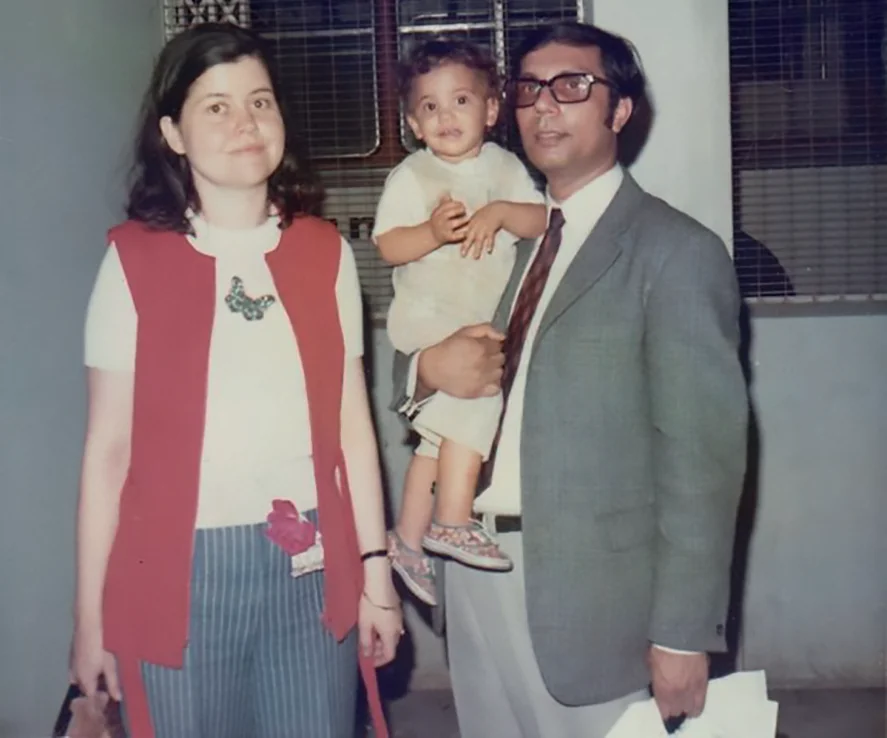
I was talking to a friend and colleague, Jacinta Nandi. She’s an author, like me. Her father comes from northeastern India, like mine. Both of our fathers grew up speaking Bengali. Her father emigrated to England, and mine to Germany, where I grew up. Jacinta’s father taught her a wealth of English puns – but, she says, “he never taught me a single word in Bengali”. Like mine.
My father always spoke German to me. Of course I heard him speak Bengali: on the phone, or to the few Indian friends living in Germany. But I couldn’t understand what he was saying. Even worse, my name, Mithu, is Bengali, but native Bengali speakers have told me that I don’t pronounce it correctly.
Yes, that’s right, I can’t even say my own name.
Up until my conversation with Jacinta I’d thought there was something seriously wrong with me. What kind of child doesn’t learn their father’s language?
Many of us, as it turns out.
Annick De Houwer is the director of the Harmonious Bilingualism Network at the University of Erfurt in Germany, and one of the world’s leading experts on how and why some families lose their languages. In 2003, she published results from a survey of language use in 18,000 families in Flanders, a Dutch-speaking region of Belgium.
“I discovered how often it happens that bilingually raised children don’t speak two languages,” explains De Houwer. The survey and later studies by De Houwer and others across different countries and languages found that between 12% and 44% of children who grow up hearing two or more languages, actually end up speaking only one language. “Most babies start by learning words in both languages. But when they go to preschool they only continue with one. And why is that? Because suddenly there is only a focus on this one part of them and children soon sense that their other language is worthless. Worthless!”
The resulting loss can have a profound impact on family relations. Parents may feel sad if their children do not speak their language. These feelings can go both ways. Janice Nakamura, professor of English at Kanagawa University in Japan, studied children in mixed families in Japan who could not speak the language of their non-Japanese parent. As adults, many felt angry with their parents. This is what Nakamura described as “language regret”: the sense of a lost opportunity, because they didn’t learn the other language.
De Houwer comments: “So whichever way you put it, it’s not good for family relations. It’s really a very important thing to speak the languages of your parents: for the parents, for the children, for the family.”
There are many things society can do to support this process, says De Houwer. One practical example is how multilingualism is treated in schools. “It is really necessary to actively – actively! – respect all the languages that children bring to the classroom and there are very simple ways of doing that. For instance, pronouncing a child’s name correctly.”
At this point in the interview I start crying, thinking of my own name and my inability to say it properly for so long. In De Houwer’s view, such small steps could make a big difference, as could simply asking children how to say “hello” in the language they speak at home: “Important things like that. And then you can learn these,” she continues. “And you can ask children to help you. And then all the children in the class are going to have to learn how to say hello to this new kid. To show an appreciation of all those different languages. It’s a matter of paying attention to it. It’s not a matter of money. It’s a matter of changing attitude.”